Head of Merchandising
I’m always one report behind.
Dashboards show what happened. By the time the picture is clear, the season has moved on.
Solya reads your sales and stock, applies your rules (open-to-buy budget, size curve, supplier minimums) and prepares your replenishment, rebalancing and markdown plans.





What we hear in retail leadership meetings:
Head of Merchandising
I’m always one report behind.
Dashboards show what happened. By the time the picture is clear, the season has moved on.
Retail Operations Director
The stock is never where the demand is.
Best-sellers sit in the wrong stores. Rebalancing comes too late, or never.
CFO, fashion retail
We only see the margin drop at the end of the season.
Markdown is decided on instinct, then justified with a deck three months later.
Buying & Planning Lead
Everything ends up in a spreadsheet.
Ten systems, one Excel file. One broken formula and the replenishment goes out wrong.
Four layers, one chain: Solya connects your systems, computes the decisions, gets them approved and writes them where your teams work.
ERPPOSPOSFinancePOS, ERP, e-commerce: one product, store and stock master.
3 signals · composed score per SKU
Transfer 12 units · Wool Coat
Lyon → Paris · confidence 0.91
Every recommendation respects your budget and your rules.
Solya writes each decision into your systems, with nothing to re-key.
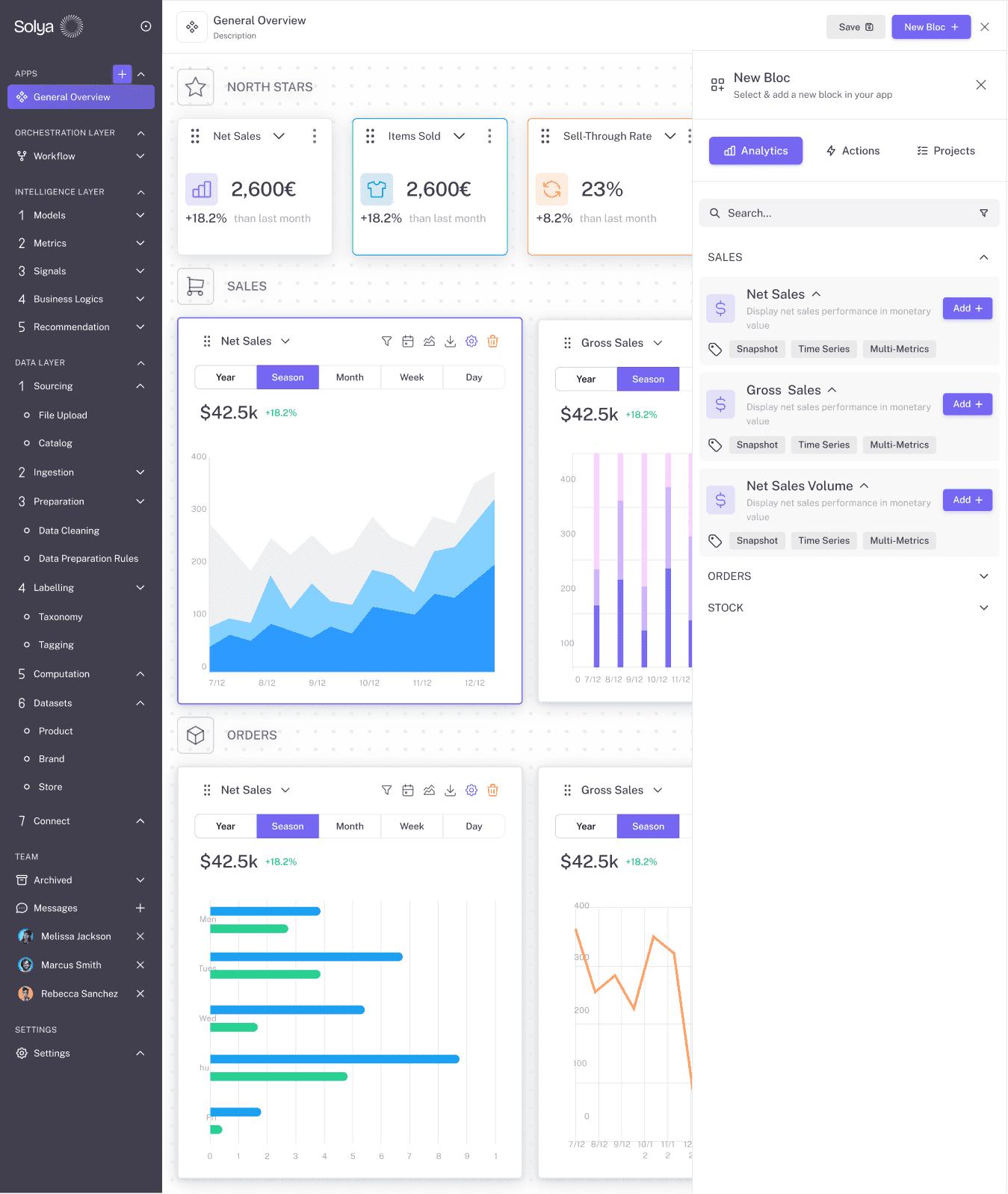
Buyer cockpit
12 buyers
Store actions
42 stores
Planning board
Planning team
Ops console
Ops & IT
One app per team: buying, planning, stores.
Agent, automation or integration: Solya plugs in.
Three entry points to one engine. MCP for people and LLMs, CLI for the shell and agents, REST API for services and integrations. All three apply the same rules and approvals, and write to the same audit trail.
What are my replenishment alerts this morning?
12 alerts detected.
Highest priority: MIDI-NOIR-38
Aggregated across Solya customers over the last twelve months. Range varies by network maturity; every deployment ships with its own baseline.
+7%
Revenue
From better allocation, faster markdown, fewer stockouts on best-sellers.
+12%
Margin
Markdown decided on real demand curves, weeks before the end of the season.
+15%
Cash flow
Inventory matched to each store’s demand, so less cash sits on the wrong shelves.
“Solya replaced four spreadsheets and two weekly meetings. Our buyers spend their week buying, not chasing data.
Yes. Solya proposes, you decide what runs automatically and what needs human approval. Every threshold, every exception, every escalation rule is yours. The default for new customers is propose-and-approve; teams move more workflows to auto-execute as trust builds.
Most networks see a first end-to-end decision (replenishment or transfers) running in 4 to 6 weeks. The intelligence layer learns from your historical decisions, so accuracy improves through the first season. The first operational gains come before that.
No. Solya was built for the retail stack as it runs: late files, conflicting masters, half-mapped SKUs. The data layer reconciles continuously and flags the gaps that change a decision.
Native connectors for the most common ERP, POS, OMS, WMS and planning tools, plus a typed API for anything custom. Solya reads, decides, and writes back: orders, transfers, price changes and tasks land in the systems your teams already use.
Operational signals (decision latency, transfer execution, order-fill) shift in weeks. Commercial outcomes (sell-through, margin, cash) materialize over one full season, because Solya is acting on the buy and the markdown, both of which take a cycle to land in the P&L.
Subscription based on network size and the number of active decision workflows. No per-seat fees on the application layer: give access to every store manager if you want. Talk to us about a tailored plan during the demo.
30 minutes, on an extract of your data: replenishment, transfers, markdown.