Buying
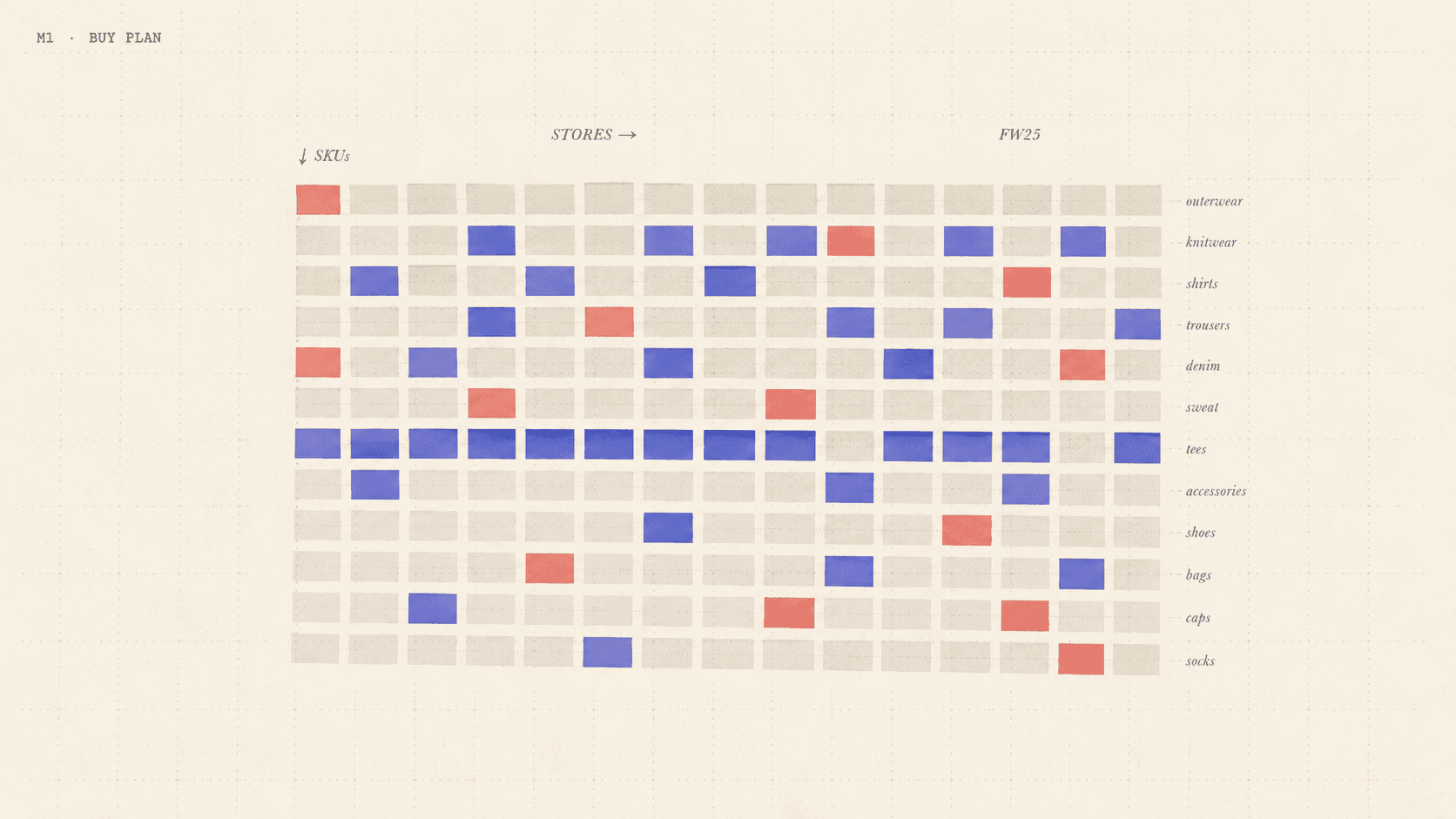
A buy plan the network director signed off in one review.

Aurélien
The retailer
A 14-store premium contemporary retailer, three buyers, five thousand five hundred SKUs.
Our retailer operates 14 stores across France in the lifestyle apparel premium contemporary segment. The team is structured: a 3-person buying team plus a dedicated merchandising lead, running roughly 5,500 SKUs in season.
The stack is mainstream for the sector — Polaris as core retail management, Shopify for e-commerce, and Excel as the connective tissue between everything else. It works. Until it doesn't.
"Every season felt like a leap of faith. We bought what we hoped would sell."
— Lead Buyer
Context
Coming off a tough year, a buying team facing a budget cut.
Spring 2025. After two consecutive seasons with disappointing full-price sell-through, the leadership team had asked the buyers to reduce the next season's open-to-buy by 12%. The pressure was real: a third consecutive miss would force the company to rethink its expansion plan for 2026.
The team had ten weeks to prepare a smaller, sharper buy. Smaller volumes meant less room for error. Every category, every supplier, every store tier had to be questioned.
The team's playbook — built on senior intuition and last-year-plus-or-minus-X — wasn't going to survive the scrutiny this time.
The Problematic
The data existed. It just never made it to the buying table.
Sell-through reports were pulled monthly, by category, in aggregated Excel exports that took two days to build. By the time the team analyzed them, three weeks had passed and the conclusions were already half-stale.
Worse: the reports were aggregated at category level, never per SKU per store. A bestselling jacket in Paris could sit on shelves in Lyon for weeks, but the Excel saw "jackets sold OK across the network." The buyer had no way to spot the patterns that mattered.
The problem showed up in three places:
Last-year-plus-X buying, driven by category trends rather than SKU-level facts.
No store-level signal, with the same buy applied to all stores regardless of local performance.
Manual reconciliation, with every meeting starting on which Excel was the right one.
The team was making decisions on data that was technically available, but operationally invisible.
The Solution
A seasonal buy built on what actually sold, where it actually sold.
Solya unified two years of sell-through data across stores, channels, and categories — at SKU × store × week granularity. For the first time, the buying team could open a dashboard and see the real performance of every product, in every store, against every week of the season.
On top of that data, Solya built a recommended buy plan: per category, per supplier, per month, respecting the new -12% budget. Every recommendation came with the data behind it — sell-through curves, store-level performance, lookalike SKUs from previous seasons.
2 years of unified data at SKU × store × week granularity.
Buy plan computed against -12% budget, MOQs, and margin floor.
Every recommendation traceable to the data and lookalikes behind it.
The team didn't replace its expertise with the model. They used the model to challenge their own assumptions — then committed to a plan that combined both.
How we did it
Inside the loop.
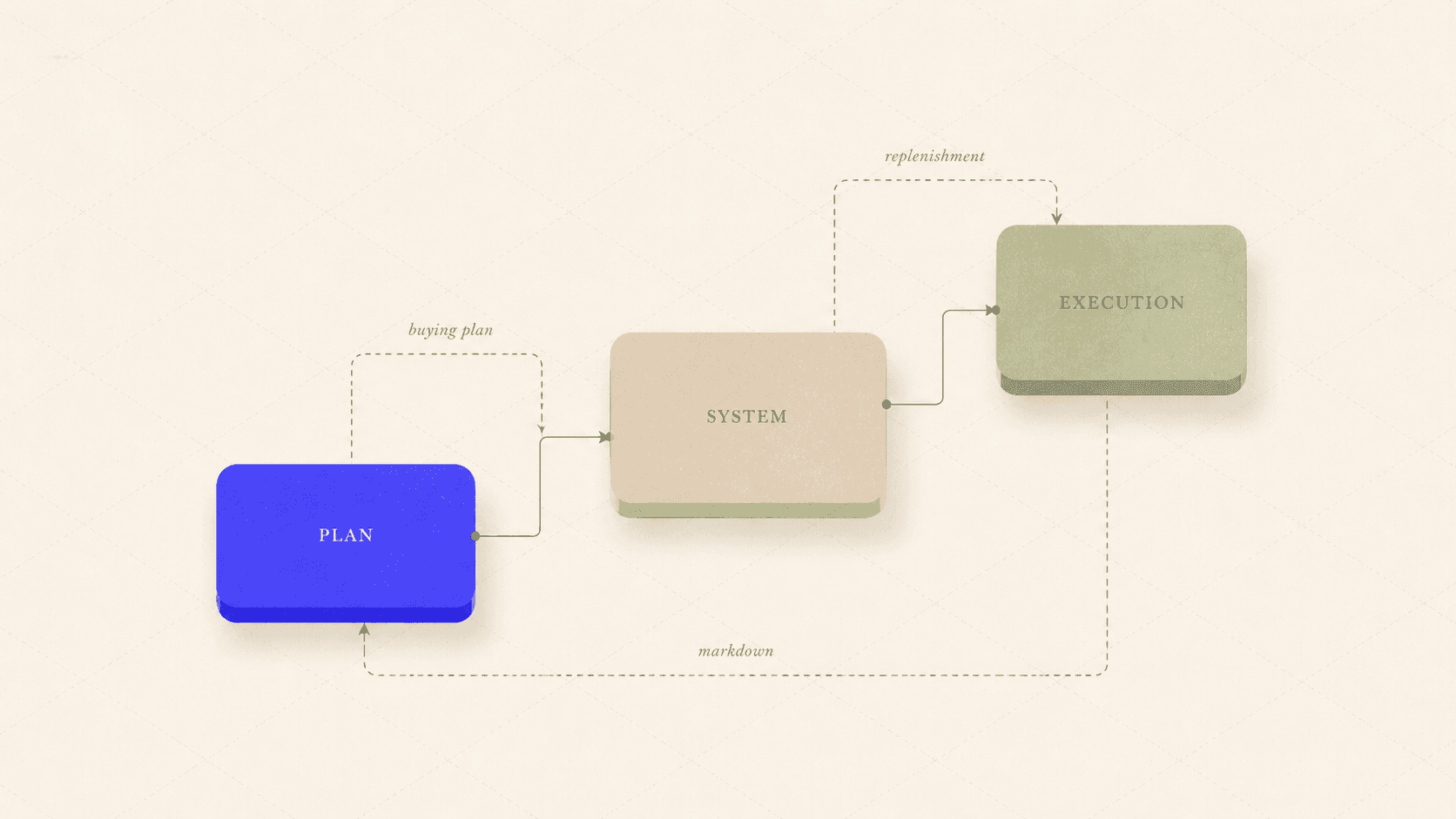
The seasonal buy plan ran on the four Solya layers, in a continuous loop between the data, the rules, and the buying team. Five steps, ten weeks, one final plan.
01 — Ingest the data.
Solya connected to Polaris and Shopify, pulled two years of historical sales, and unified them into a single retail data model. Three days from contract to data flowing.
02 — Structure for retail.
Sales data was reorganized at SKU × store × week, with auto-tagging on category, season, and lifecycle stage. The team could now query any combination, instantly.
03 — Compute the truth.
Sell-through curves, full-price share, and inventory cover were calculated per SKU and per store. Slow movers, hidden bestsellers, and store-level patterns surfaced for the first time.
04 — Recommend the buy.
Solya proposed a buy plan per category, respecting the −12% budget, the supplier MOQs, and the team's margin floor. Every recommendation was traceable to the data behind it.
05 — Validate together.
The buying team reviewed every category, accepted, adjusted, or overrode. Solya logged every decision and the reasoning behind it. The final plan was a hybrid: 70% of Solya's recommendations, 30% of buyer adjustments.
What used to be a sequence of disconnected meetings, exports, and reconciliations became a single loop the team could trust — and the network director could read in one go.
The Impacts
A plan committed three weeks early, validated in one review.
After the first season running on the Solya buy plan, the results landed measurable on three fronts: speed, margin, and team confidence.
−12% — OTB reduction absorbed without losing volume on bestsellers.
70 / 30 — Final plan split: Solya recommendations / buyer adjustments.
2 days → 3 hours — Time to refresh sell-through analysis.
Zero meetings — About which Excel was the right one.
"The first season the network director didn't ask us to redo our numbers."
— Lead Buyer
Explore more use cases
One platform. Every retail decision.
Inventory, allocation, pricing, planning, execution — connected in a single operational layer.