Operations
AI agents handling daily loops.

Aurélien
The retailer
A 10-store casual apparel retailer with two senior planners stuck on tactical work.
Our retailer operates 10 stores across France in the casual apparel / athleisure segment. The team is structured: a 2-person buying team plus an operations manager, running roughly 4,500 SKUs in season across stores and a small e-com extension. Marie and Pierre — both with 10+ years of retail experience — spent 70% of their week on daily operational loops.
The stack is mainstream for the sector — Fastmag as core retail management, Shopify for e-commerce, and Excel as the connective tissue between everything else. It works. Until it doesn't.
"We had two senior planners doing daily firefighting. We didn't need fewer planners — we needed less firefighting."
— Operations Manager
Context
Two senior planners stuck on daily loops.
2024. The casual apparel retailer's ops team had two senior planners — Marie and Pierre — both with 10+ years of retail experience. Both spent 70% of their week on daily operational loops: replenishment computation, rebalancing decisions, markdown alert triage.
The operations manager knew the cost. Marie and Pierre were strategic assets, stuck on tactical work. The intuition was: AI agents could handle the daily loops, freeing them for strategy. But every previous AI tool the team had evaluated required them to babysit it more than the manual work itself.
The team didn't lack senior talent. They lacked the leverage to deploy it.
The Problematic
Senior planners doing daily loops the system should handle.
Replenishment took Marie three hours every morning: pull sales, check stock, factor in lead times, generate orders, validate exceptions, push to Fastmag. Rebalancing took Pierre two hours: identify divergent stores, compute transfers, coordinate with warehouse. Markdown alerts took both of them another two hours combined.
The work was important. It was also, fundamentally, repetitive. Every previous AI tool had failed because it required validation on every recommendation — turning the loop into a different loop, not eliminating it.
Three compounding issues:
70% of senior planner time on daily operational loops.
Previous AI tools required so much validation they offered no leverage.
Strategic work (network design, supplier renegotiation) constantly deprioritized.
The team didn't need fewer planners. They needed less firefighting.
The Solution
Three pre-built agents, running daily, with human oversight only on exceptions.
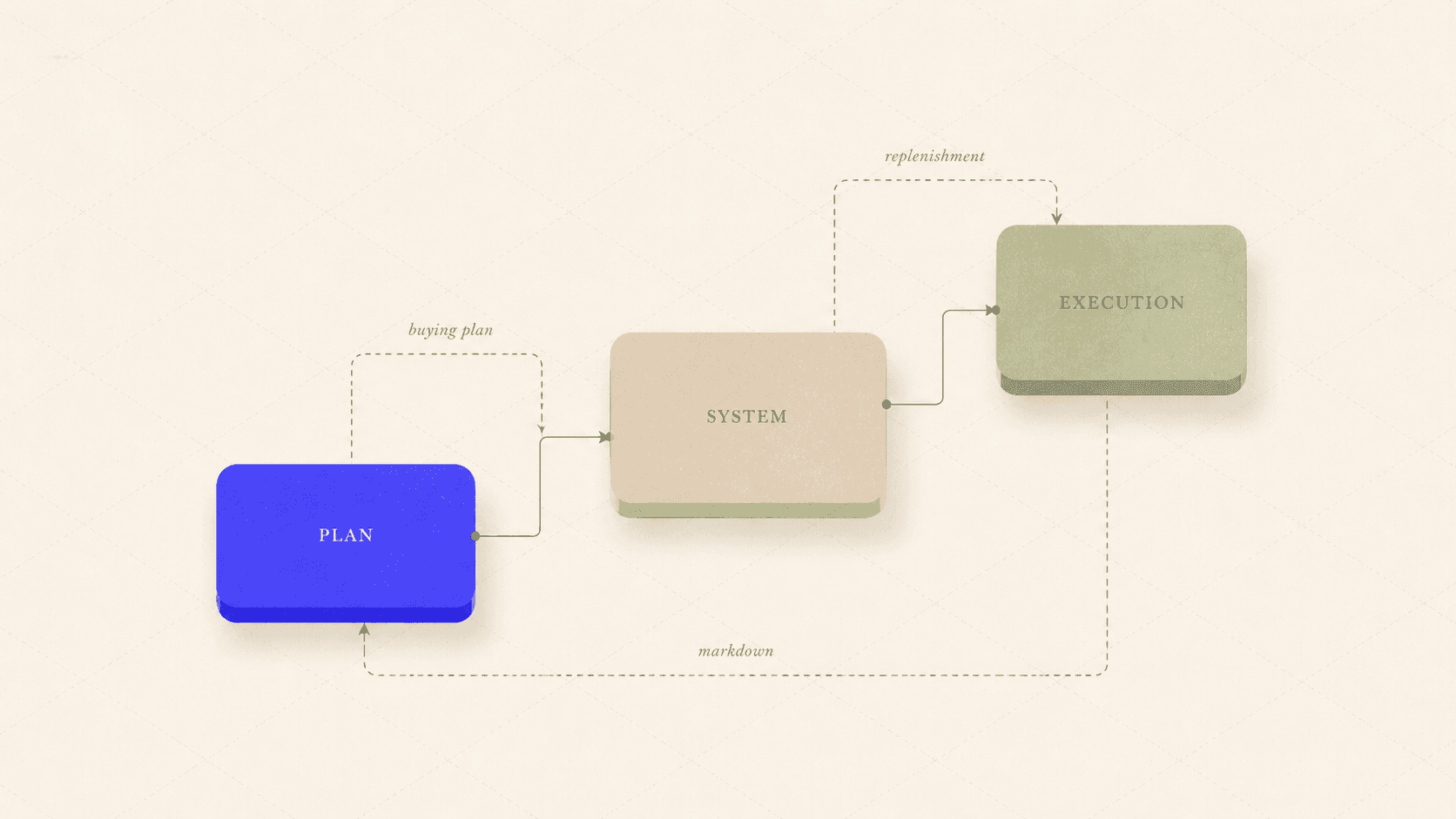
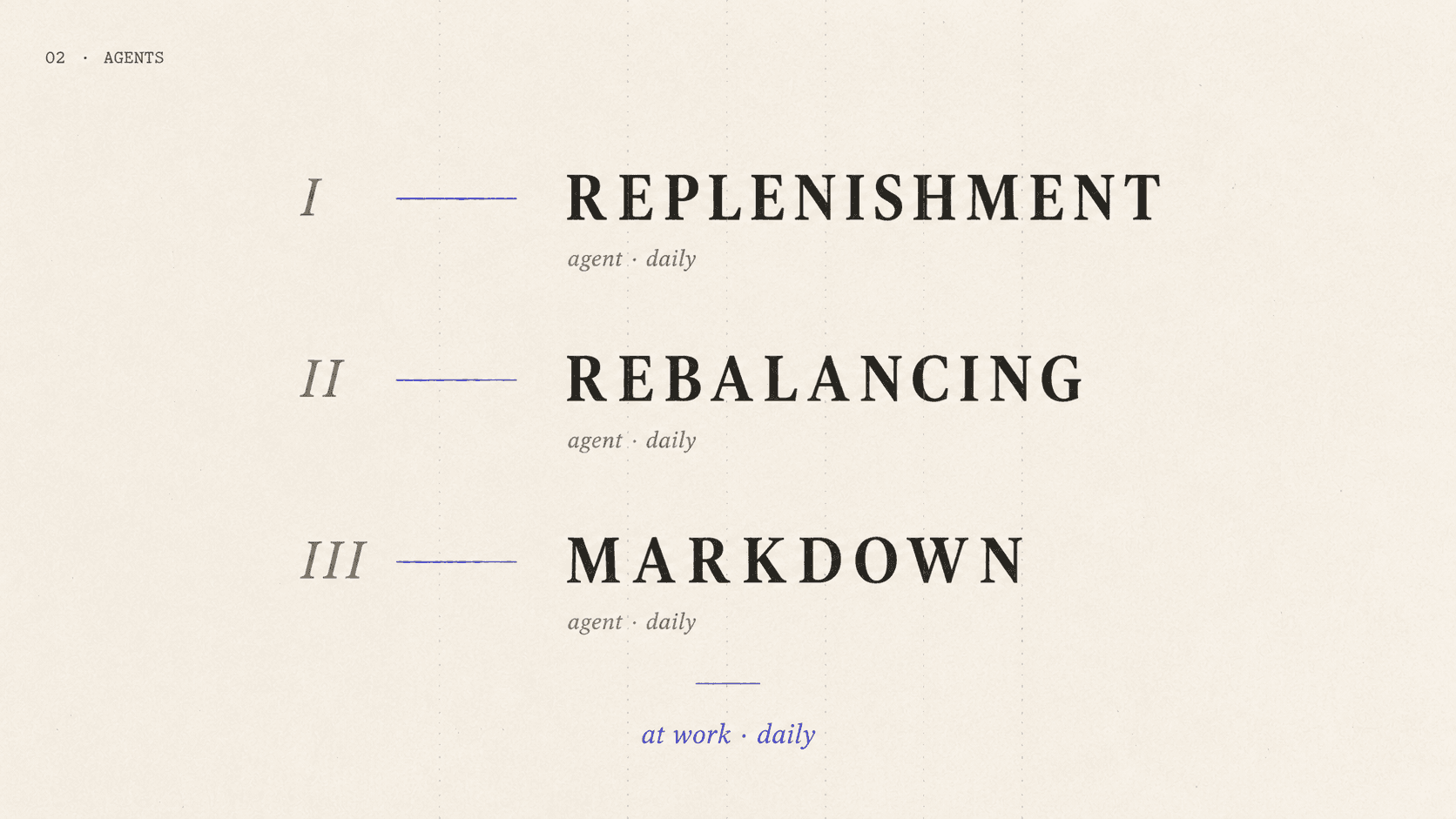
Solya deployed three pre-built agents: a replenishment agent, a rebalancing agent, a markdown alert agent. Each one ran daily, autonomously, on the team's metrics, signals, and constraints. Each one made decisions within clear boundaries — and surfaced only what fell outside those boundaries to Marie and Pierre.
Day 1, the agents ran on shadow mode (humans validated, agents learned). Week 4, the agents ran live with human oversight only on exceptions. Marie and Pierre got 60% of their week back — and started a network design project that had waited two years.
Pre-built retail agents — replenishment, rebalancing, markdown alerts.
Confidence thresholds — autonomous above, human-in-the-loop below.
Clear boundaries — every action governed by team constraints.
The agents didn't replace the planners. They freed them.
How we did it
Inside the loop.
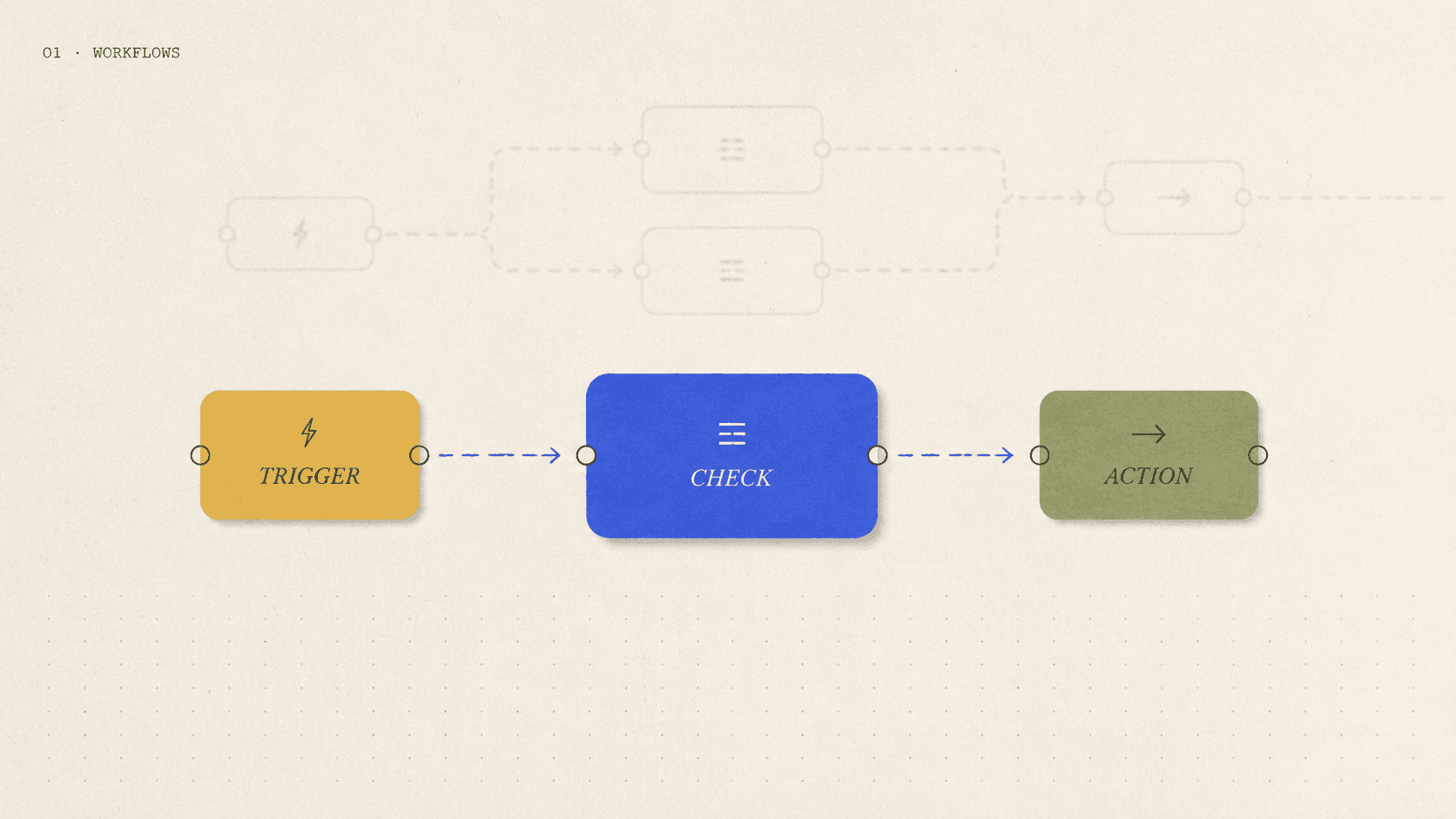
The three agents ran on Solya's orchestration layer, with the team transitioning from validators to overseers in four weeks. Here's how the system works, end to end.
01 — Deploy pre-built agents.
Solya's library of retail agents included replenishment, rebalancing, and markdown alert agents. Each was configured against the team's metrics, signals, and constraints in two days.
02 — Run in shadow mode.
For two weeks, agents ran but didn't act. Marie and Pierre validated every recommendation. Solya logged agreements and disagreements.
03 — Tune confidence thresholds.
Based on shadow-mode data, the team set confidence thresholds: above threshold, the agent acts autonomously; below, it surfaces to a human.
04 — Go live with human-in-the-loop.
Agents started acting on high-confidence decisions. Edge cases flowed to Marie or Pierre. The boundary was clear and adjustable.
05 — Iterate and trust.
Every week, the team reviewed agent decisions and outcomes. Confidence grew. Thresholds adjusted. The autonomy boundary moved over time.
The agents didn't replace the planners. They freed them.
The Impacts
Two strategic minds, no longer stuck on daily loops.
After two months running with the three agents live, Marie and Pierre operated as strategic resources for the company — not as daily firefighters.
3 agents — Running daily, autonomously.
60% — Of senior planner time reclaimed.
Live — In Solya today.
Network design — Strategic project finally started.
"Marie and Pierre stopped doing junior work. They started shaping the network."
— Operations Manager
Explore more use cases
One platform. Every retail decision.
Inventory, allocation, pricing, planning, execution — connected in a single operational layer.