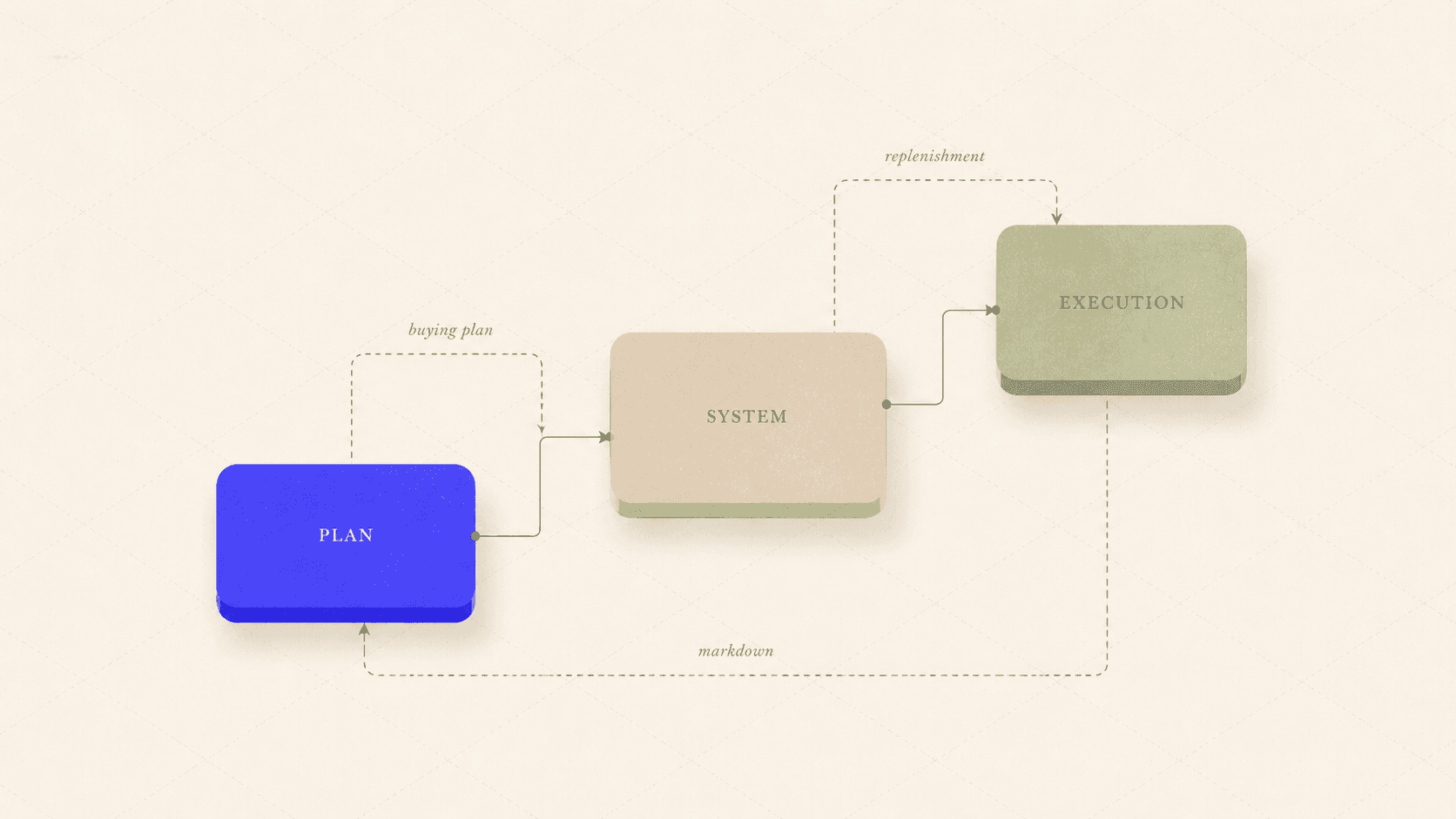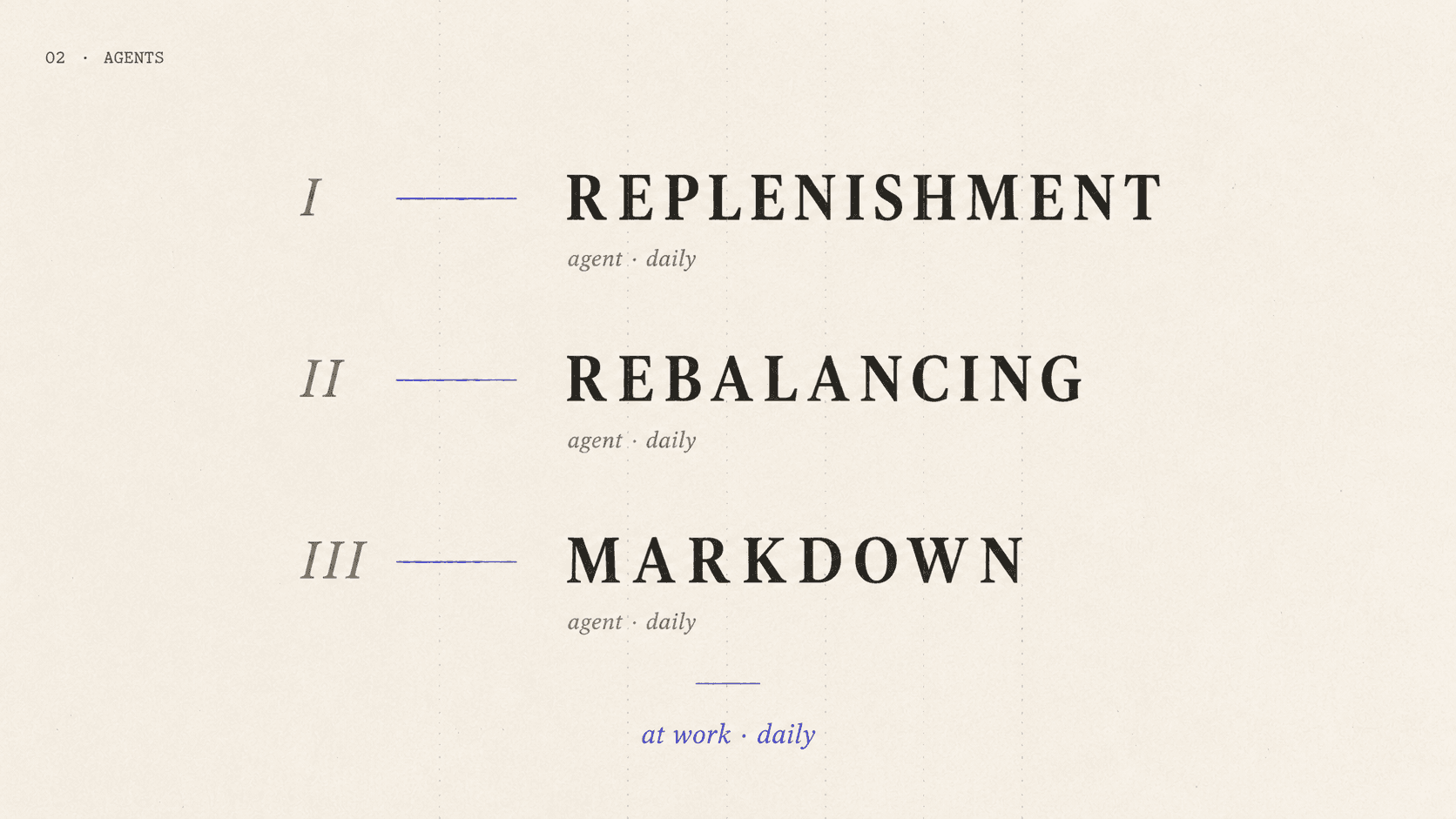
Operations
Workflows that act on signals.

Aurélien
The retailer
A 10-store casual apparel retailer where the team had become the workflow.
Our retailer operates 10 stores across France in the casual apparel / athleisure segment. The team is structured: a 2-person buying team plus an operations manager, running roughly 4,500 SKUs in season across stores and a small e-com extension.
The stack is mainstream for the sector — Fastmag as core retail management, Shopify for e-commerce, and Excel as the connective tissue between everything else. It works. Until it doesn't.
"Four people, four spreadsheets, four Mondays. We were the workflow."
— Operations Manager
Context
Four weekly rituals that consumed the team's Monday and Tuesday.
2024. The casual apparel retailer ran on a set of weekly rituals: stockout review (Monday morning), markdown alert review (Monday afternoon), inter-store transfer planning (Tuesday morning), supplier reorder validation (Tuesday afternoon). Each ritual involved one person, one Excel, and one set of decisions.
The team had grown to 10 stores. The Excels had grown more complex. Two days a week were lost to the rituals — leaving three days for actual operational improvement work.
The team didn't lack discipline. They lacked leverage.
The Problematic
The same loops, every week, by hand.
Each ritual followed a clear pattern: pull data, apply rules, generate decisions, push actions. The pattern was identical. The execution was manual.
The team kept saying: this should be automated. But every automation attempt required IT capacity they didn't have. So the rituals continued. Every Monday, every Tuesday, the same loop.
Three friction points compounded:
Same pattern repeated four times a week, all manually.
Each ritual blocked one person for half a day.
No-code workflow tools didn't speak retail; coded automation needed IT.
The team had been the workflow. They needed to stop being the workflow.
The Solution
A visual workflow builder, native to retail signals.
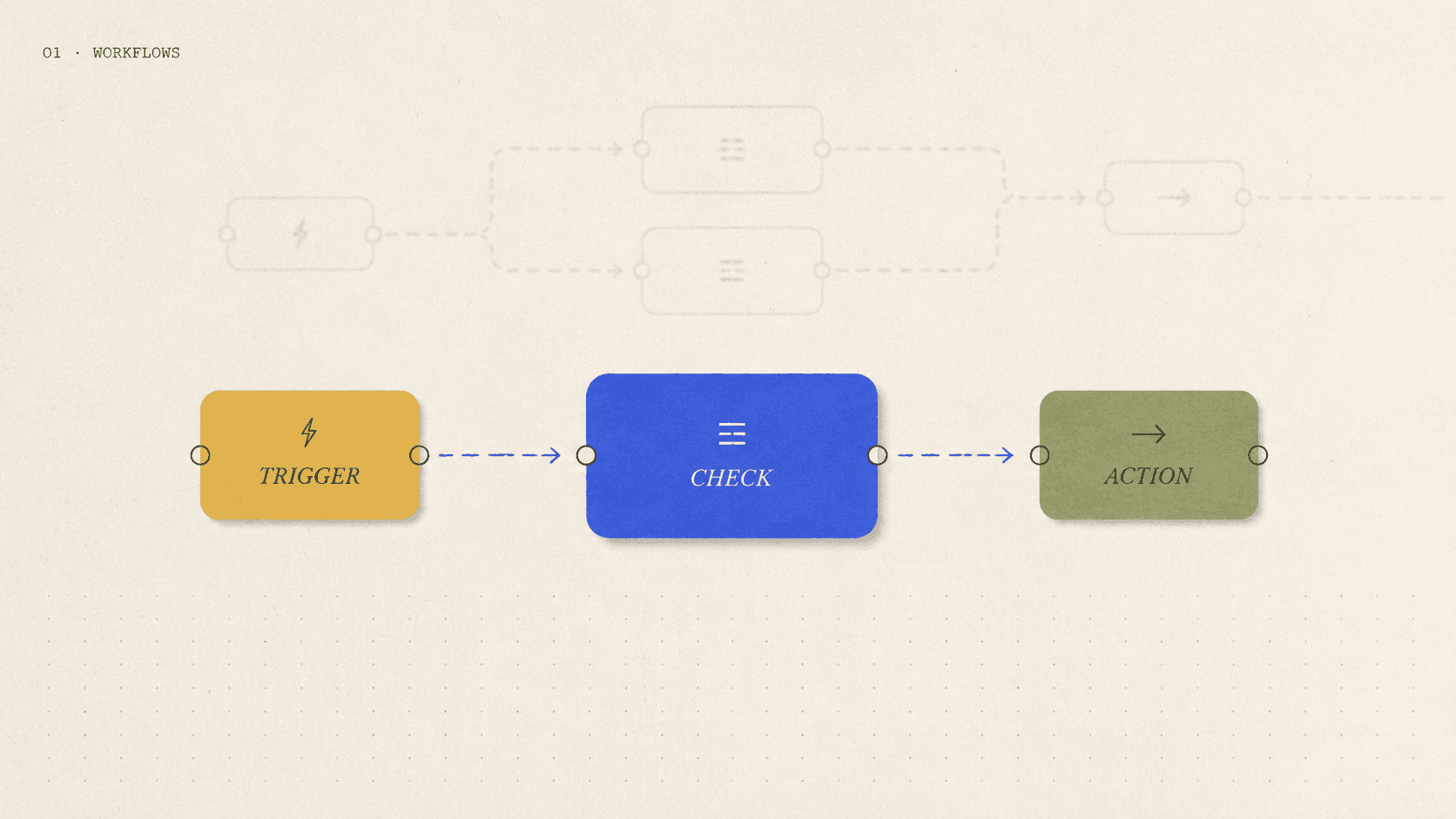
Solya's orchestration layer let the operations manager build the four rituals as visual workflows. Each one followed the same logic: trigger (a signal), constraints (business rules), action (push to a system or notify a team).
The stockout review became: trigger 'stockout signal' → check 'within reorder budget' → action 'create draft PO in Fastmag, notify buyer.' The whole flow ran in seconds, every time the trigger fired. No code, no IT ticket. Built on a Tuesday afternoon.
Trigger — native retail signals from Solya's intelligence layer.
Constraints — business rules pre-declared once, applied automatically.
Action — pre-built blocks: PO creation, store notification, ticket open.
The team stopped running the workflow. They started supervising it.
moq ≥ 6
notify(buyer)
How we did it
Inside the loop.
Each ritual was rebuilt as a workflow on Solya's orchestration layer. The operations manager built them visually, in hours, without IT. Here's how the system works, end to end.
01 — Map each ritual.
The operations manager mapped each weekly ritual: trigger, decisions, actions, exceptions. The pattern surfaced as four similar workflows.
02 — Build the trigger.
Each trigger came from Solya's signal layer: stockout signal, slow-mover signal, transfer-needed signal, reorder signal. No custom code.
03 — Apply constraints.
Business rules from the constraints layer (margin floors, MOQs, store tiers) plugged in visually. The workflow respected them by construction.
04 — Define the action.
Actions ranged from 'create draft PO in Fastmag' to 'notify buyer in Slack' to 'open transfer ticket in warehouse system.' Each action was a pre-built block.
05 — Run and adjust.
Workflows ran continuously. The team reviewed exceptions weekly. Adjustments were made visually, in minutes, without involving IT.
The team stopped running the workflow. They started supervising it.
The Impacts
Two days reclaimed. Four loops automated.
After the four workflows went live, the operations team reclaimed two days per week and shifted from execution to exception management.
4 → 1 — Weekly rituals automated.
2 days — Reclaimed per week per team member.
0 IT — Tickets opened during build.
Live — Signal-to-action loops.
"We stopped being the workflow. We started running the operation."
— Operations Manager
Explore more use cases
One platform. Every retail decision.
Inventory, allocation, pricing, planning, execution — connected in a single operational layer.