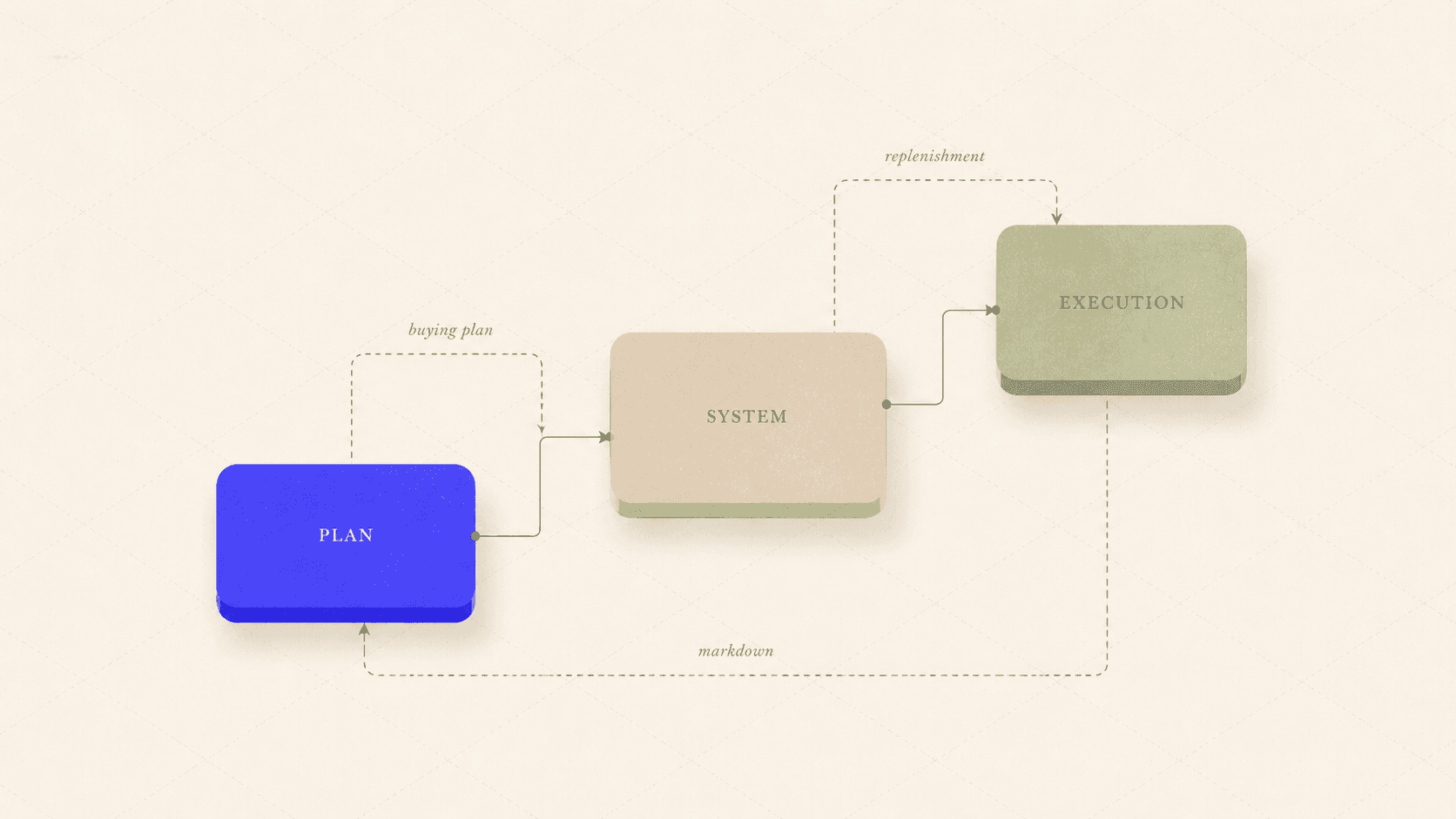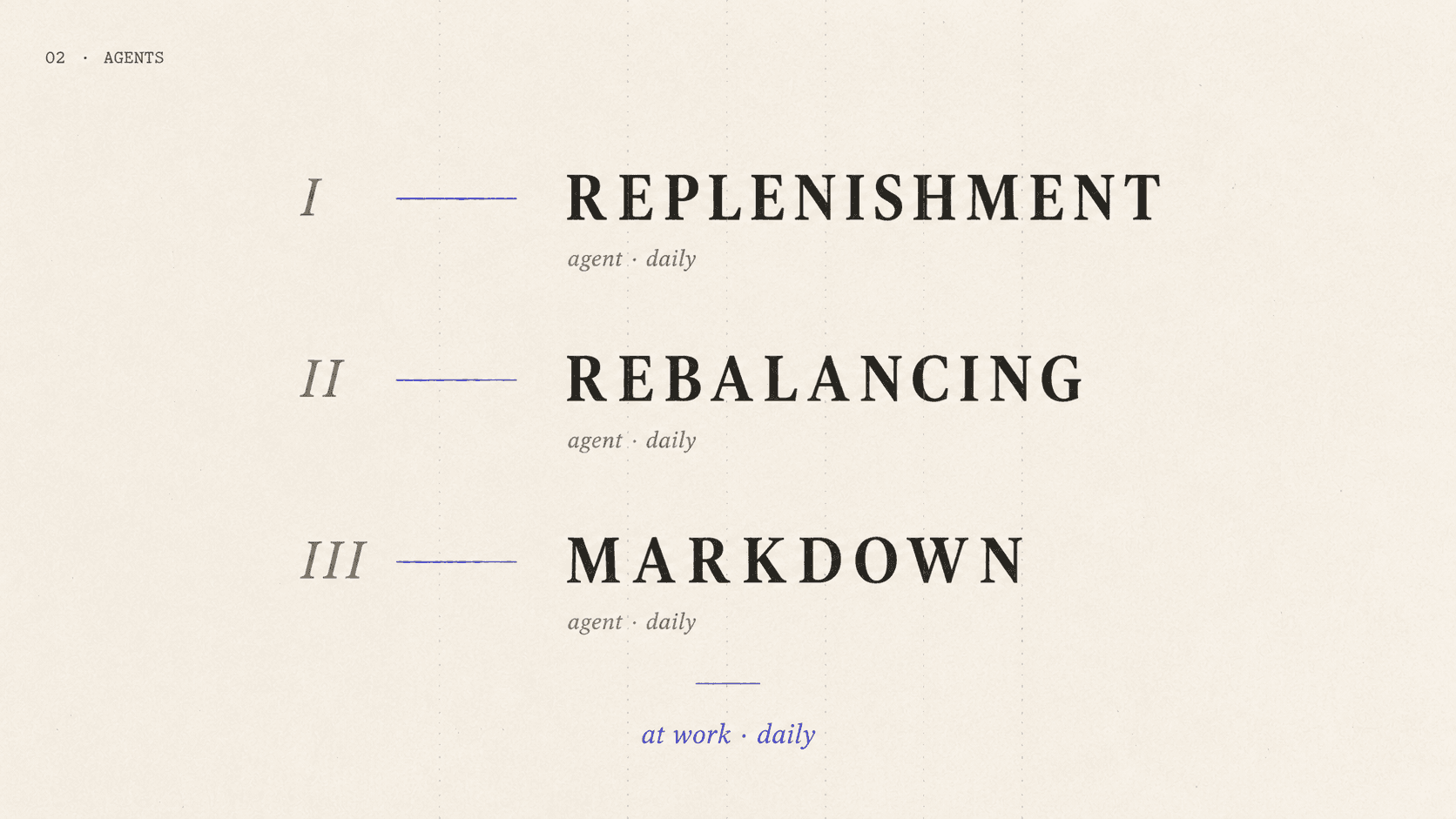
Allocation
Daily reorders, ready to ship.

Aurélien
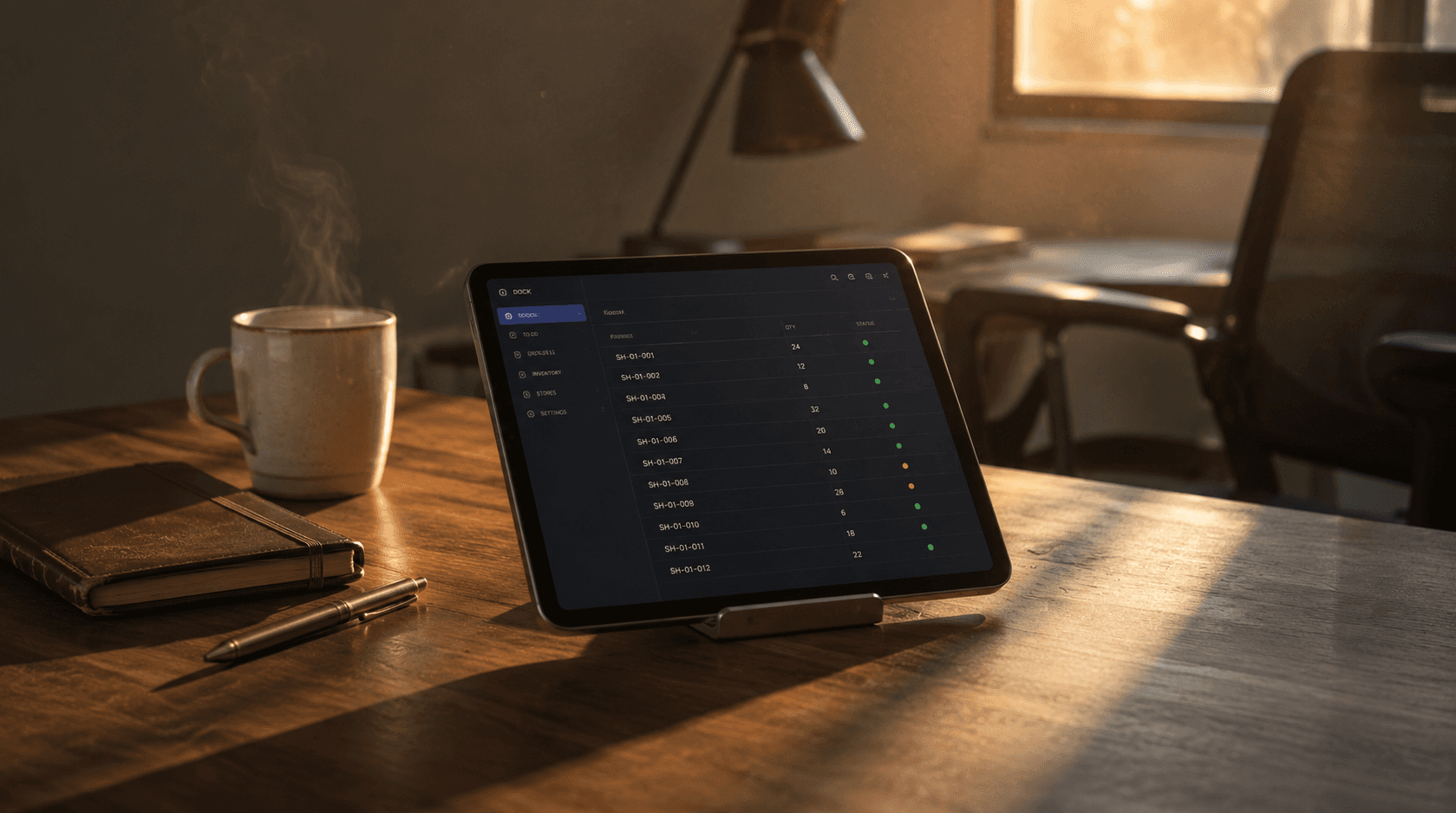
The retailer
A 16-store sport retailer with a weekly reorder ritual that no longer scaled.
Our retailer operates 16 stores across France in the sport multi-brand specialty segment — running, fitness, technical apparel. The team is structured: a 3-person buying crew plus a dedicated allocator, running roughly 7,000 SKUs in season across stores and a small e-com extension.
The stack is mainstream for the sector — Ginkoia as core retail management, Shopify for e-commerce, and Excel as the connective tissue between everything else. It works. Until it doesn't.
"Mondays were lost to reorders. By Wednesday, we were already late."
— Allocation Lead
Context
Sixteen stores, daily reorders, one allocation lead drowning every Monday.
Spring 2025. The sport retailer ran on a weekly replenishment cycle that had worked when the network was 8 stores. With 16 stores and 7,000 SKUs in season, the Monday reorder routine had become a full-day Excel exercise.
The allocation lead spent every Monday reconciling sales reports, stock levels, and supplier lead times across categories. By the time orders were sent, three to five days had passed. The bestsellers that ran out on Saturday were back on shelves the following Wednesday — at best.
The data updated daily. The team's response cycle didn't.
The Problematic
Replenishment was a weekly batch when stores needed it daily.
Sales reports came out Monday morning. The allocation lead opened her Excel, cross-referenced stock with the latest deliveries, computed the right reorder per SKU per store, and sent the file to the buyers for validation. Validation came Tuesday afternoon. Orders went to suppliers Wednesday. Restocking happened Thursday-Friday.
Meanwhile, every store had been losing sales since Saturday. On bestsellers, that was a week of stockouts every two weeks.
Three symptoms compounded:
Weekly batch when sell-through happened daily, especially on weekends.
Manual reconciliation between sales, stock, and lead times — every category.
Three-to-five-day lag between stockout and restock, structurally.
The team had the data to act faster. They just had no way to act faster on it.
The Solution
Daily AI-recommended reorders, ready before the team starts.
Solya runs every night. It pulls the day's sales from Ginkoia, the latest stock levels from each store, and the open POs from suppliers. By 6am, every buyer has a personal list of reorder recommendations — per SKU, per store, with confidence ranges and lead time alerts.
The team doesn't build the reorder anymore. They review it. Most days, 80% of recommendations are validated as-is. The remaining 20% gets human attention: edge cases, supplier issues, strategic decisions.
Nightly run — sales, stock, POs ingested by midnight, ready by 6am.
Per-buyer personal list — high-confidence reorders pre-checked.
Constraints respected — margin floors, MOQs, supplier minimums.
The allocation lead stopped working on Mondays. She started planning on them.
How we did it
Inside the loop.
The daily reorder loop runs autonomously every night. The team reviews, adjusts, and ships in the morning. Here's how the system works, end to end.
01 — Pull every signal at midnight.
Solya ingests the day's sales from Ginkoia, store-level stock from POS, and supplier confirmations. Three minutes from midnight to ready data.
02 — Compute reorder needs per SKU.
Solya calculates the optimal reorder per SKU per store, factoring in sell-through trend, current cover, supplier lead time, and the team's safety stock rules.
03 — Apply business constraints.
Margin floors, MOQs, supplier minimums, store capacity — every constraint is respected by construction. No recommendation breaks the team's rules.
04 — Surface a personal list per buyer.
Each buyer wakes up to a personal recommendation list, ordered by impact. High-confidence reorders are pre-checked. Edge cases are flagged for review.
05 — Ship in one click.
After review, the buyer hits 'send.' Orders go to suppliers, alerts go to stores, the loop closes. Solya logs every action and learns from it.
What used to take Monday now takes 15 minutes — and runs every day.
The Impacts
From weekly grind to daily flow.
After three months running on Solya's daily reorder loop, the allocation lead reclaimed five days of cadence per week, stockouts dropped sharply on bestsellers, and the team operated on shared, daily-fresh data.
5 days — Of replenishment cadence reclaimed (daily vs weekly).
−22% — Stockouts on top-100 bestsellers.
15 min — Daily review time per buyer.
80% — Of recommendations validated without changes.
"Mondays became strategy days. That alone changed how I work."
— Allocation Lead
Explore more use cases
One platform. Every retail decision.
Inventory, allocation, pricing, planning, execution — connected in a single operational layer.