Markdown
From -50% in January to -20% in November.

Aurélien

The retailer
A 14-store premium contemporary retailer, three buyers, five thousand five hundred SKUs.
Our retailer operates 14 stores across France in the lifestyle apparel premium contemporary segment. The team is structured: a 3-person buying team plus a dedicated merchandising lead, running roughly 5,500 SKUs in season.
The stack is mainstream for the sector — Polaris as core retail management, Shopify for e-commerce, and Excel as the connective tissue between everything else. It works. Until it doesn't.
"Every January, the same scene. Winter stock cleared at half price. We knew it three months earlier — but we had no way to act."
— Head of Buying
Context
FW 2024. A buying team facing the same January as every other year.
By October 2024, the buying team already knew the picture: winter outerwear was selling slower than planned, with a clear divergence between bestselling silhouettes and a long tail of slow movers. The CFO had set a clear FW24 target: protect at least 4 points of gross margin compared to FW23.
The team had eight weeks to act. The problem wasn't visibility — it was speed of action. Their existing markdown process couldn't move faster than monthly. By December, the only remaining lever would be depth. And −50% would become the default again.
The Problematic
Markdown was a quarterly review when it needed to be a weekly signal.
The team's existing process worked like this: aggregated weekly reports showed slow movers 3 to 4 weeks late. Markdown waves were applied at category level, not SKU level — meaning items that were still selling fine got discounted alongside the actual underperformers.
By December, the only lever left was depth, and −50% became the default. Margin disappeared. The team knew. The CFO knew. Nobody had a way to break the cycle.
Three structural failures:
Slow movers spotted 6+ weeks after the demand drop.
Markdown waves applied to whole categories instead of individual SKUs.
30%+ of margin lost on winter clearance, every year.
The team wasn't deciding markdown. They were rescuing the season.
The Solution
Markdown turned from a quarterly review into a weekly signal.
Solya watches sell-through, stock cover, and demand drift on every SKU, every store. The moment a SKU drifts below its expected curve, a signal fires. The team sees slow movers six weeks earlier than before — when there's still time to react.
When markdown is the right answer, Solya proposes a depth and timing per SKU, computed against the team's margin floor and inventory cover targets. The buyer reviews, adjusts, overrides if needed. Approved markdowns are pushed to the POS. Every override is logged and feeds back into the model.
Daily monitoring of sell-through and stock cover, per SKU per store.
Per-SKU markdown depth — not blanket category waves.
Margin-floor aware — pricing rules respected by construction.
Winter clearance stopped being an emergency. It became a continuous lever.
How we did it
Inside the loop.
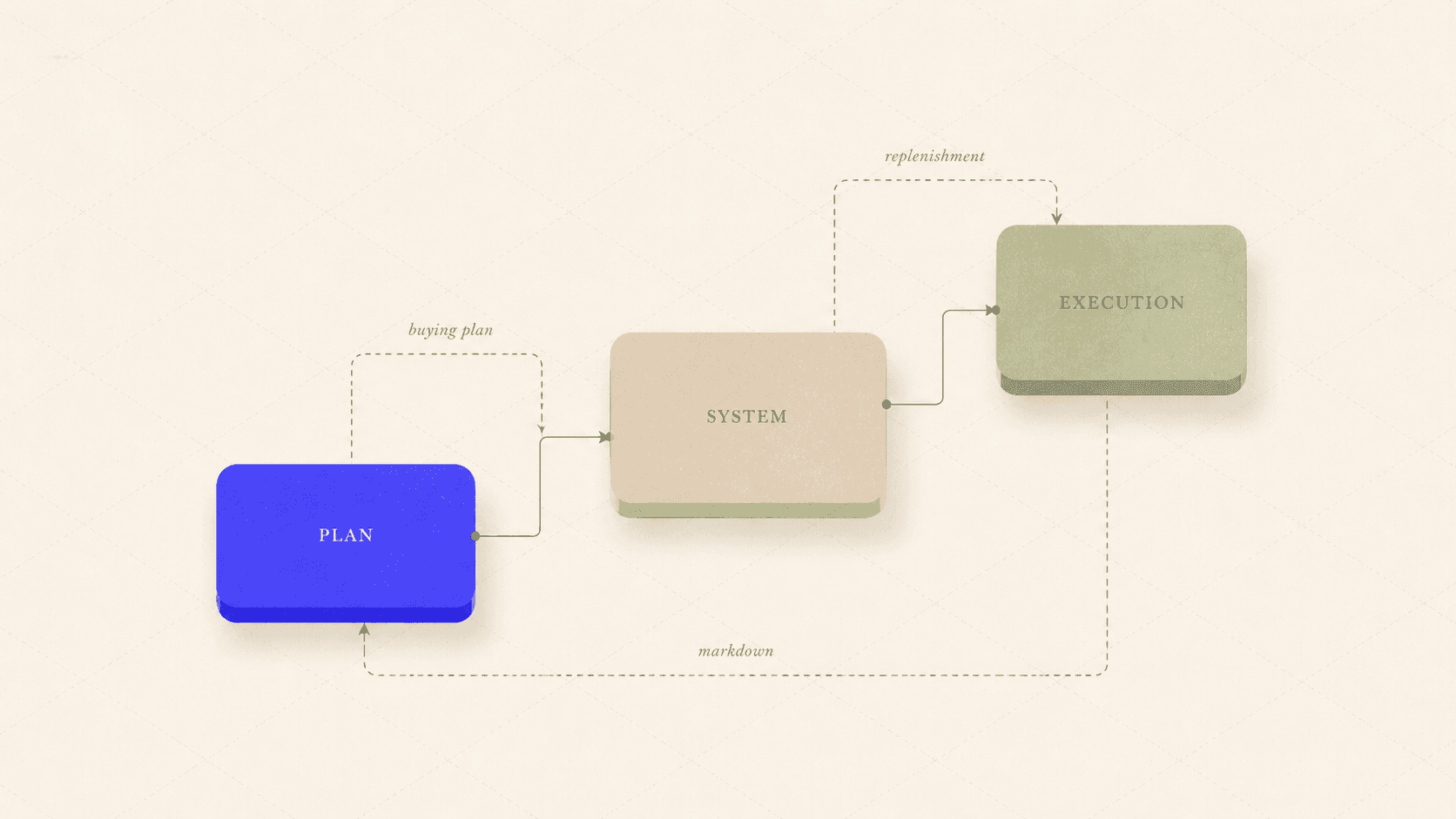
The markdown loop runs continuously. The buying team intervenes at three moments: review, adjust, ship. Here's how the system works, end to end.
01 — Watch every SKU, every store.
Solya tracks sell-through, stock cover, and demand drift per SKU per store, daily. Slow movers are flagged within days, not weeks.
02 — Detect drift early.
When a SKU's sell-through falls below the expected curve by a defined margin, Solya raises a signal. Confidence ranges and lookalike SKU patterns are surfaced.
03 — Compute markdown depth.
For each flagged SKU, Solya proposes a markdown depth and timing — respecting the margin floor, the inventory cover target, and the team's pricing rules.
04 — Surface to the buyer.
The buyer reviews proposed markdowns weekly. Each row shows the why: drift pattern, recommended depth, expected impact on margin and stock cover.
05 — Push and learn.
Approved markdowns are pushed to Polaris and applied at the POS. Solya logs every override and adjusts the model for the next round.
Markdown stopped being a January problem. It became a continuous lever.
The Impacts
Margin defended, season after season.
After two FW seasons running the markdown loop, the team stopped clearing winter stock at −50%, started markdown waves at −20%, and protected meaningful margin per season.
−30% — Markdown average depth (from −38% to −22%).
+6 weeks — Slow movers caught earlier.
+€80k — Margin protected per season on €5M turnover.
95% — Of recommendations executed without override.
"We stopped fighting markdown. Now we steer it."
— Head of Buying
Explore more use cases
One platform. Every retail decision.
Inventory, allocation, pricing, planning, execution — connected in a single operational layer.