Operations
From 80% overrides to 15%.

Aurélien

The retailer
A 9-store streetwear retailer, two buyers, three thousand five hundred SKUs.
Our retailer operates 9 stores across France in the streetwear contemporary unisex segment. The team is small and focused: a 2-person buying team running roughly 3,500 SKUs in season on a drop-driven calendar.
The stack is mainstream for the sector — Polaris as core retail management, Shopify for e-commerce, and Excel as the connective tissue between everything else. It works. Until it doesn't.
"We were overriding the AI more than we were using it. At some point, we asked: what's the point?"
— Head of Buying
Context
A team that wanted to trust AI, but couldn't.
2024. The streetwear retailer had been running an AI forecasting tool for 18 months. The vendor was reputable, the model was solid — on paper. In practice, the team overrode 8 out of 10 recommendations.
The issue wasn't the model's accuracy. It was that the model didn't know the brand's reality: hype-driven drops, intentional limited editions, supplier-side exclusivity windows, in-store theater. The model recommended like a generic retailer. The team operated like a streetwear brand.
The model was right in theory. It was wrong in practice.
The Problematic
The AI was right in theory and wrong in practice.
The previous AI vendor's model optimized for textbook outcomes: maximize sell-through, minimize stockouts, balance margin. But streetwear isn't a textbook. A drop is supposed to sell out — that's the point. A flagship store gets disproportionate inventory because of brand theater. A limited edition gets overordered on purpose, even if the model says no.
None of this was in the model. So the team overrode constantly, then questioned why they were paying for an AI that couldn't think like they did.
Three mismatches stacked up:
Model trained on generic retail patterns, blind to streetwear brand mechanics.
Recommendations on hype drops felt naive — "sell-out is the goal" missing from the math.
80% override rate eroded trust week by week.
The team didn't need a smarter model. They needed a model that knew their business.
The Solution
Recommendations computed inside the team's real constraints.
Solya started with a different premise: the rules of the brand come first, the model comes second. The buying team encoded their reality — drop mechanics, exclusivity windows, brand theater inventory rules, hype-driven sell-out targets — into Solya's constraints layer.
From there, every recommendation respected what the team actually cared about. The model wasn't smarter than before. It was aligned. Override rate dropped from 80% to 15% in three months. The team stopped questioning the AI — and started using it.
Streetwear-specific constraints encoded with the team — drops, theater, exclusivity.
Override-driven discovery — every override surfaced a missing rule.
Weekly recalibration — rules refined as new patterns emerged.
Trust wasn't claimed. It was earned, override by override.
How we did it
Inside the loop.
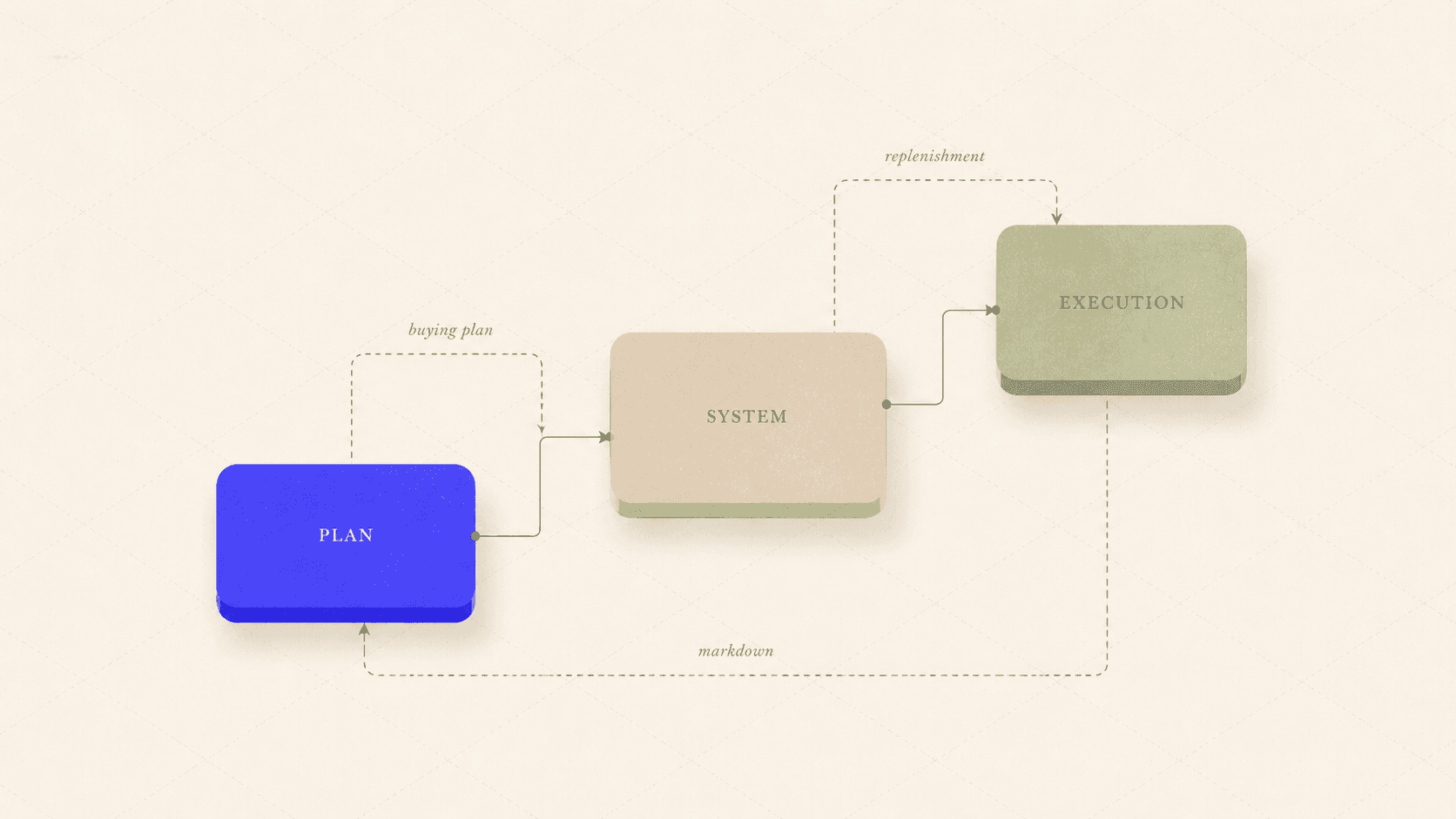
The trust-building loop ran on the Intelligence Layer, with the buying team teaching Solya their real rules. Here's how the system works, end to end.
01 — Surface the unwritten rules.
The team and Solya ran a series of override-review sessions. Every override revealed an unwritten rule the previous model didn't know.
02 — Encode each rule.
Each surfaced rule went into Solya's constraints layer: drop mechanics, exclusivity windows, brand theater allocation, hype targets.
03 — Recompute against new rules.
Solya regenerated recommendations with the encoded rules in place. The team reviewed, accepted more, overrode less.
04 — Track override patterns.
When overrides did happen, Solya logged the pattern. Recurring overrides surfaced rules that were still missing or miscalibrated.
05 — Iterate weekly.
Every week, the team reviewed override patterns with Solya. Rules were refined, added, retired. Trust grew measurably each cycle.
Trust wasn't claimed. It was earned, override by override.
The Impacts
An AI the team finally listened to.
After three months of rule-by-rule alignment, override rate dropped sharply and the team integrated Solya's recommendations into their daily routine.
80% → 15% — Override rate in 3 months.
100% — Of business constraints respected.
30+ — New rules encoded with the team.
Trust — Earned, override by override.
"We stopped fighting the AI. Because the AI stopped ignoring what we know."
— Head of Buying
Explore more use cases
One platform. Every retail decision.
Inventory, allocation, pricing, planning, execution — connected in a single operational layer.