Replenishment
Move stock before markdown is the only option.

Aurélien

The retailer
A 9-store streetwear retailer, two buyers, three thousand five hundred SKUs.
Our retailer operates 9 stores across France in the streetwear contemporary unisex segment. The team is small but sharp: a 2-person buying team, running roughly 3,500 SKUs in season on a drop-driven calendar — three product launches per season.
The stack is mainstream for the sector — Polaris as core retail management, Shopify for e-commerce, and Excel as the connective tissue between everything else. It works. Until it doesn't.
"We knew which stores had the wrong stock. We just always realized it too late."
— Head of Buying
Context
Nine stores, three drops a season, and stock moving in the wrong direction.
FW 2024. The streetwear brand operated on a drop-driven calendar with strong hype effects on flagship stores and slower curves on secondary locations.
By week 8 of every drop, the picture was clear: bestsellers were sold out where the demand was, and full racks were sitting where it wasn't. The team knew. The data showed it. But by the time someone organized the transfer logistics, week 12 had arrived — and markdown was already on the calendar.
The intent was right. The window was wrong.
The Problematic
Inter-store transfers were a manual headache, so they never happened.
Identifying which SKU to move, from which store, to which other store, was a multi-step process: pull store-level sell-through, cross-reference with stock, factor in store capacity, coordinate logistics with the warehouse. Each step was a different Excel.
The one person who could orchestrate it all — the merchandising lead — had a hundred other things to do. So transfers happened twice a season, in panic mode, at the worst possible time.
Three friction points blocked the team:
Manual SKU identification across nine stores, every time.
No view of store capacity or logistics window from the buyer's screen.
Decision delayed until markdown discussions, when transfers no longer move the needle.
The team had the right intent. They lacked the workflow to act on it.
The Solution
Live transfer recommendations, every Monday morning.
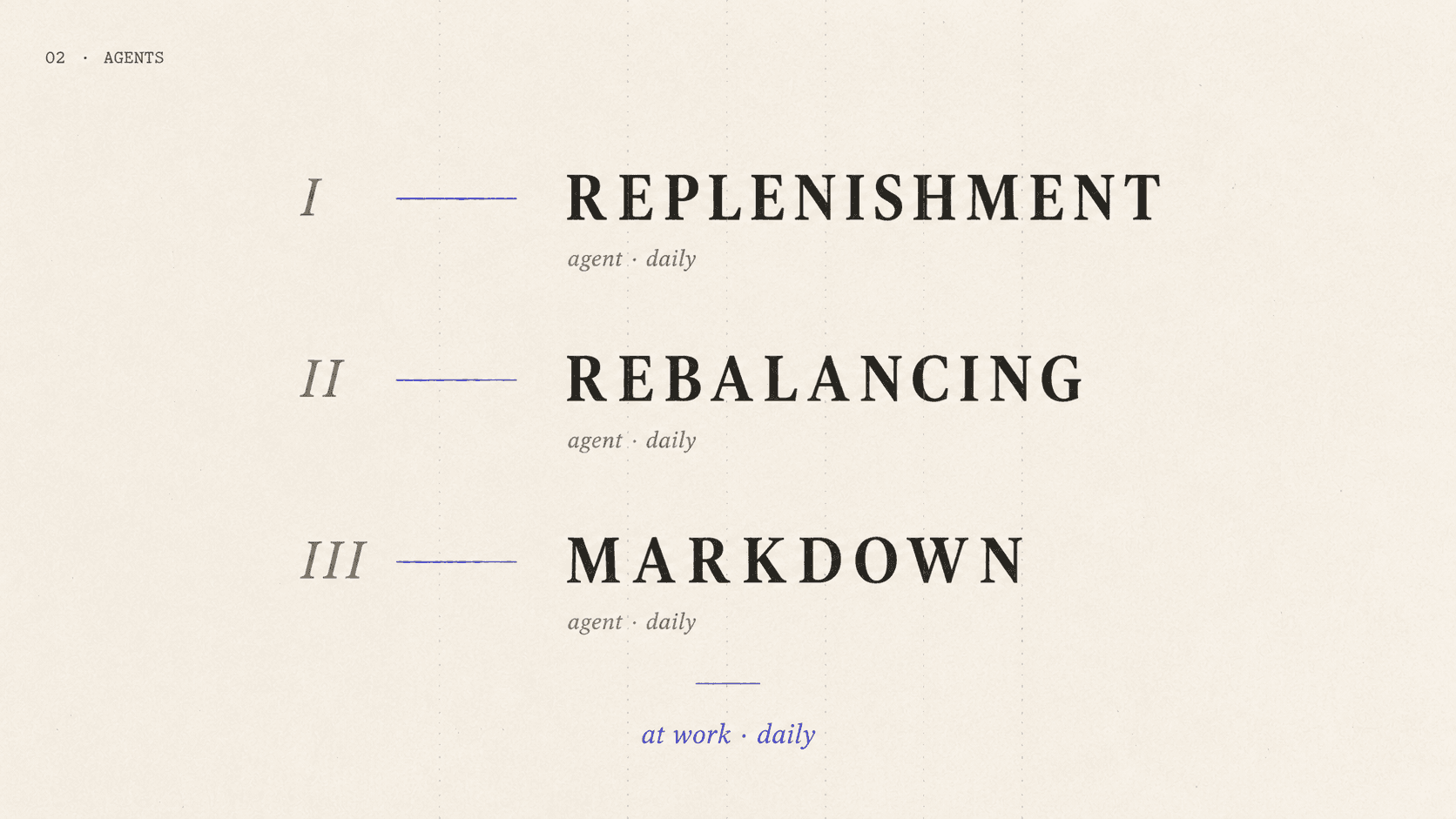
Solya analyzes sell-through, stock cover, and store capacity across the nine stores, every day. When a SKU shows clear divergence — selling out fast in store A while sitting on dead stock in store B — Solya proposes a transfer. With the right quantity, the right destination, the right window.
Every Monday, the merchandising lead reviews a curated list of transfer recommendations. Most weeks, half the list is approved as-is. Logistics gets the order Tuesday. The transfer happens by Thursday.
Daily monitoring of sell-through and stock cover across nine stores.
Curated weekly list, ordered by margin impact, with the divergence pattern visible.
One-click approval, then the transfer flows to warehouse logistics.
What used to be a panic exercise twice a season became a calm rhythm every week.
How we did it
Inside the loop.
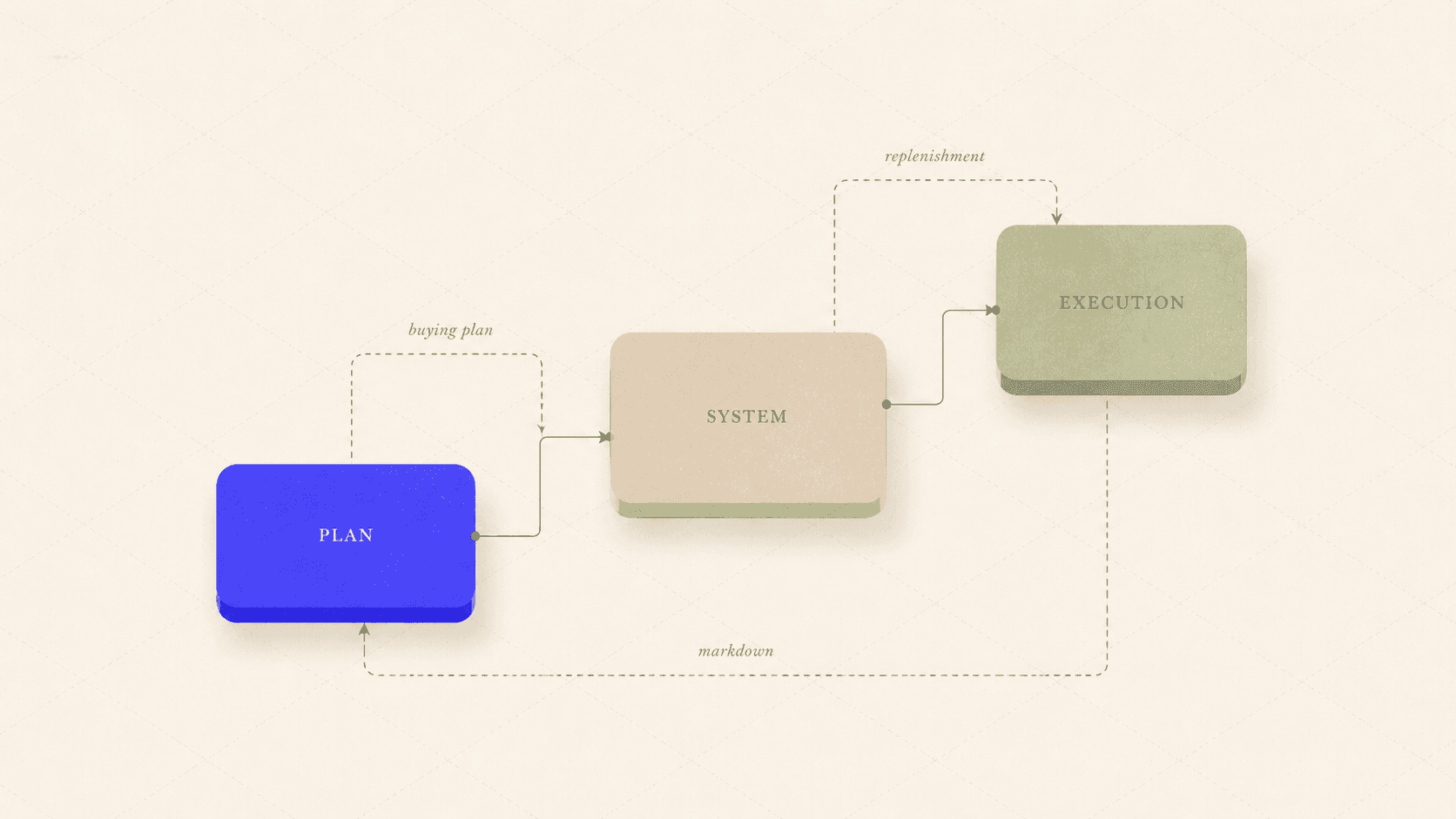
The weekly transfer loop runs on three Solya layers, with the merchandising lead as the human gatekeeper. Here's how the system works, end to end.
01 — Track every SKU, every store.
Solya monitors sell-through, current stock, and demand trend per SKU per store, daily. Divergence patterns surface within 48 hours of forming.
02 — Identify transfer candidates.
When a SKU shows opposite trends in two stores — selling fast in A, stuck in B — Solya flags it. The candidate list is filtered by minimum quantity, transfer cost, and remaining season.
03 — Compute the right move.
For each candidate, Solya calculates the optimal quantity to transfer — leaving safety stock in the source store, respecting receiving store capacity, factoring in expected demand.
04 — Surface every Monday.
The merchandising lead receives a weekly list of transfer recommendations, ordered by margin impact. Each row shows the why: divergence pattern, expected outcome, confidence.
05 — Approve and ship.
Approved transfers flow to the warehouse logistics team. Solya logs the transfer, tracks the outcome, and learns from cases where the transfer didn't deliver as expected.
Transfers stopped being a season-end emergency. They became a weekly lever.
The Impacts
Stock moved before markdown was the only answer left.
After two seasons running the weekly transfer loop, end-of-season residual stock dropped, margin recovered, and the team stopped fearing the last weeks of the calendar.
−28% — End-of-season residual stock.
+4 weeks — Transfer window opened earlier.
+€42k — Margin protected per season.
Weekly — Transfer cadence (vs twice a season).
"We stopped clearing stock at -50%. Because we'd already moved the right stock six weeks earlier."
— Merchandising Lead
Explore more use cases
One platform. Every retail decision.
Inventory, allocation, pricing, planning, execution — connected in a single operational layer.