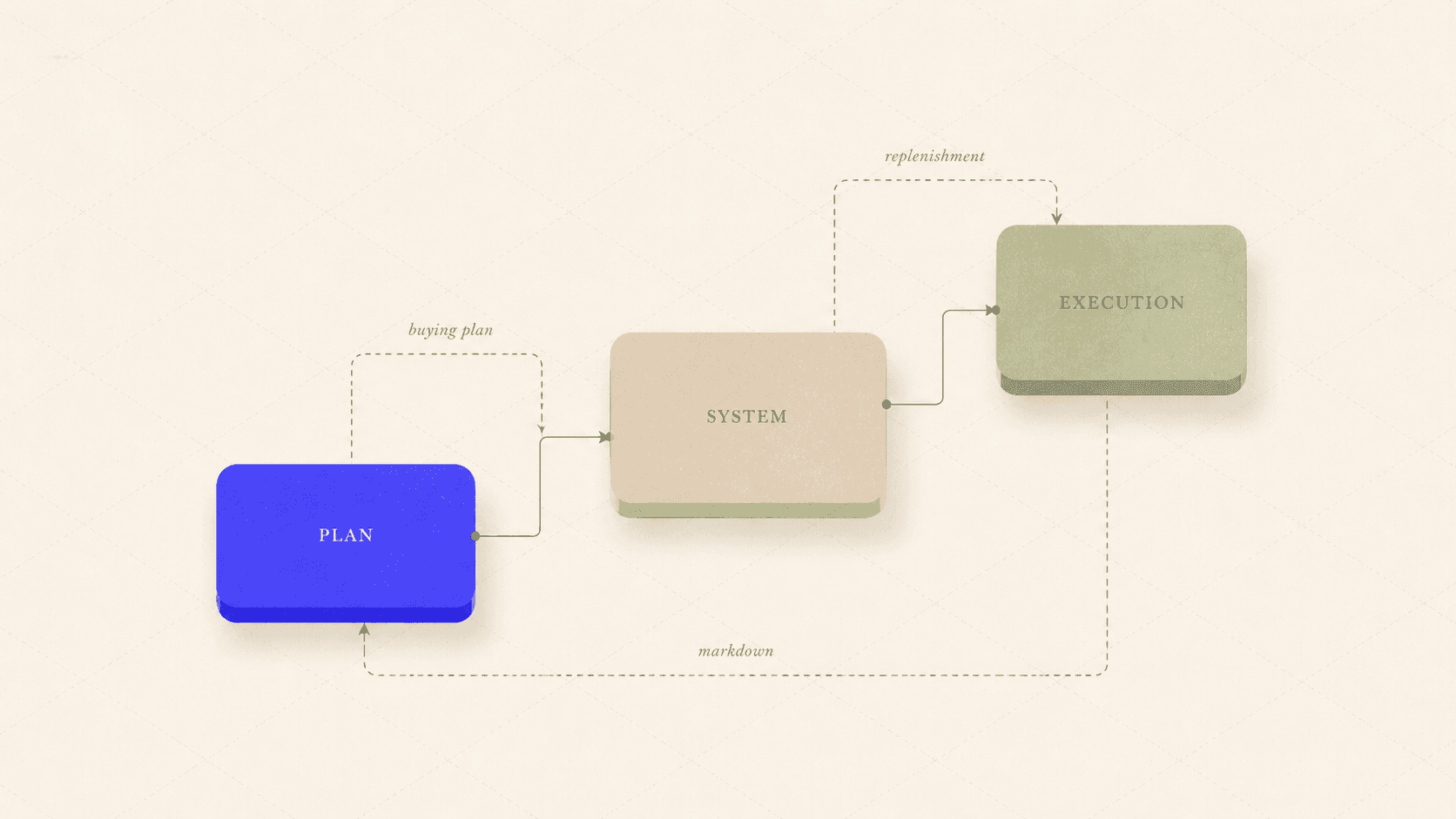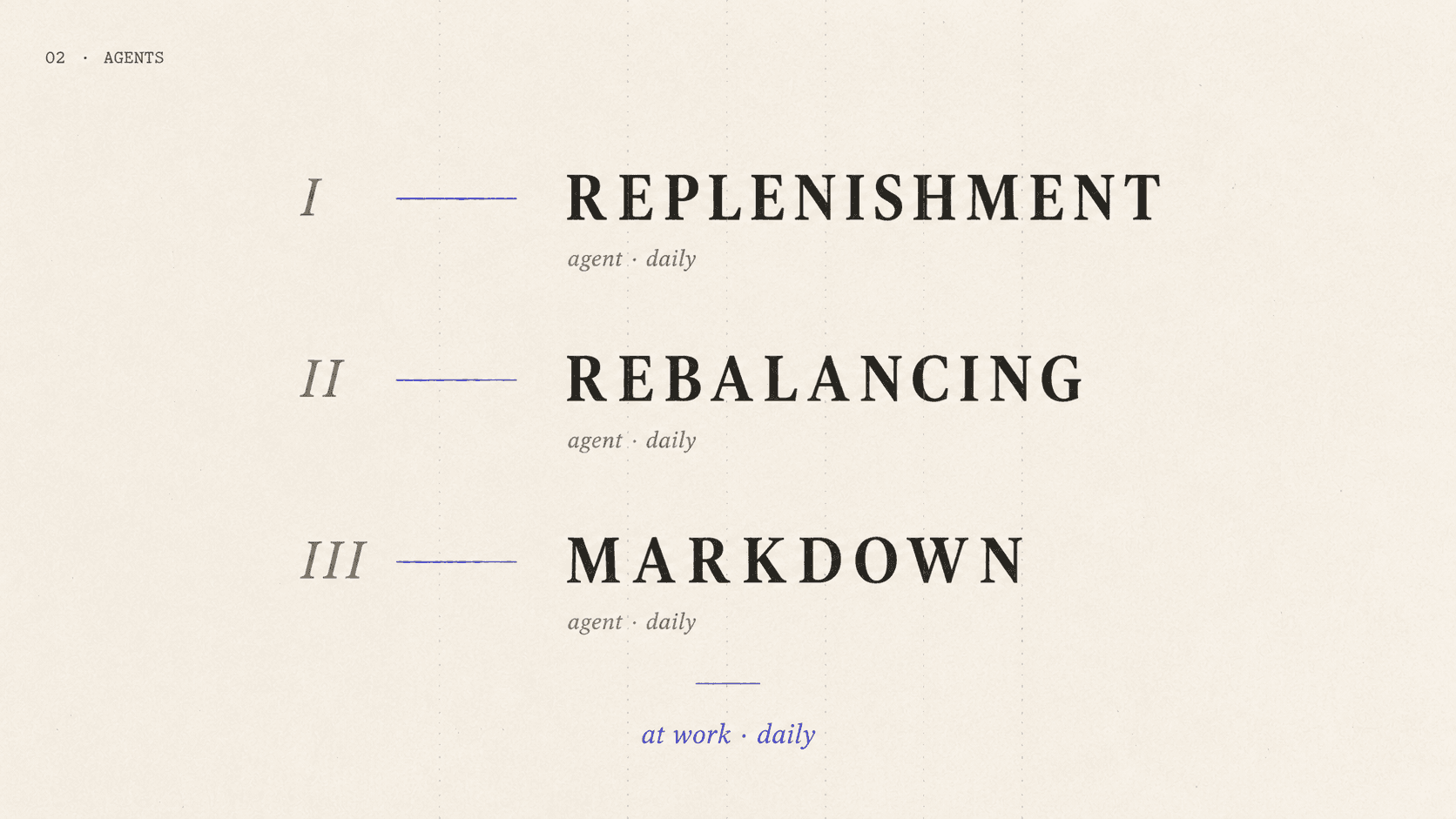
One backbone for every system.

Aurélien
The retailer
A 12-store lifestyle retailer running on five disconnected systems.
Our retailer operates 12 stores across France in the lifestyle apparel multi-canal mid-market segment. The team is structured: a 3-person buying team, a 1-person operations lead, and a 1-person merchandiser, running roughly 6,500 SKUs in season across stores, e-commerce, and marketplaces.
The stack is mainstream for the sector — LCV Mag as core retail management, Shopify for e-commerce, and three marketplaces — Galeries Lafayette, Veepee, Zalando — for additional channels. Excel as the connective tissue between everything else. It works. Until it doesn't.
"Five systems, five truths. Every meeting started with: which one is right?"
— Operations Lead
Context
A retailer running on five systems that didn't talk to each other.
2024. The lifestyle retailer ran on five distinct systems, each holding its own truth about products, sales, and stock. Reconciling them was a manual job that took two days every month.
When the operations lead took over, she inherited a Frankenstein architecture: five connectors built ad-hoc by previous staff, none of them maintained, half of them broken. She knew the company couldn't scale on this foundation.
The Problematic
Every system spoke its own dialect.
Product references didn't match across systems. Sales aggregations differed by store-vs-channel attribution. Stock levels lived in three places, often contradicting. Building a single answer to a simple question — 'how many of this SKU are left?' — required three queries, three exports, and one Excel.
Worse: the marketplaces had their own product taxonomies, completely disconnected from the in-store catalog. A bestseller on Veepee might not even be findable in LCV Mag without manual mapping.
Three structural failures:
Five systems, five product taxonomies, no automatic reconciliation.
Stock levels in three places, often contradicting each other.
Two days per month spent reconciling instead of analyzing.
The data existed five times. The truth existed nowhere.
The Solution
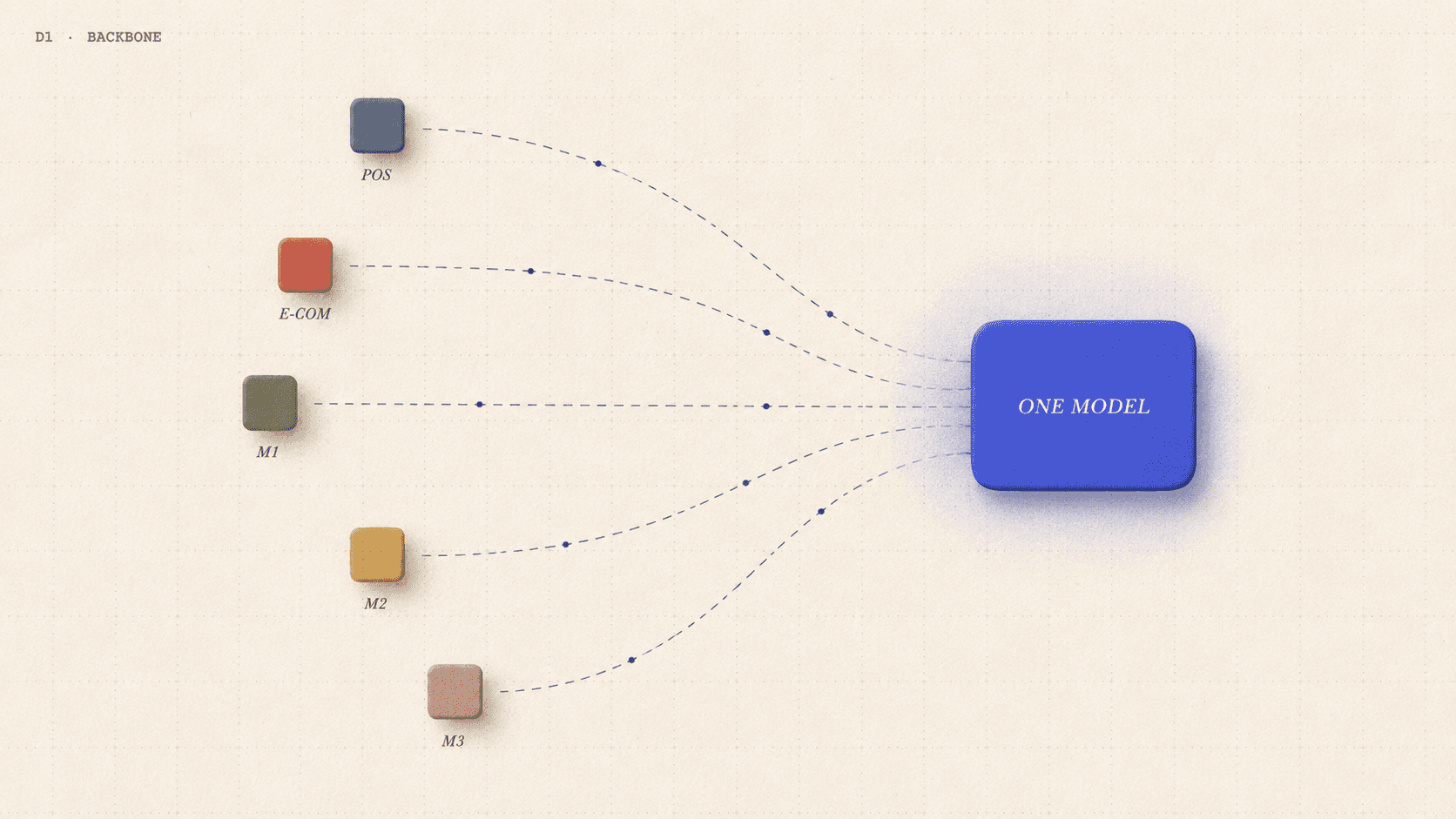
One canonical model, fed by every system, accessed by every team.
Solya connected to LCV Mag, Shopify, and the three marketplaces using native connectors. It pulled product, transaction, stock, and customer data from each, and unified them into a single canonical retail model — where one SKU is one entity across all systems, with all its sales, all its stock, all its history.
Three weeks from contract to a live, queryable data model. The operations lead stopped reconciling. She started analyzing. And the rest of the company started building on a foundation that didn't require explanation every Monday.
Native connectors to every system — no custom integration project.
Auto-detected schemas mapped to the canonical model.
Continuous sync — every change propagates in real time.
Five systems didn't disappear. They stopped being a problem.
How we did it
Inside the loop.
The data backbone ran on the Data Layer, with Solya's auto-configuration handling most of the heavy lifting. Here's how the system works, end to end.
01 — Connect every system.
Solya's native connectors plugged into LCV Mag, Shopify, and the three marketplaces in days. No custom integration project.
02 — Auto-detect schemas.
Solya analyzed each system's data structure automatically, mapped fields to the canonical retail model, and surfaced ambiguities for human review.
03 — Reconcile and unify.
Product references, customer records, and transactions were matched across systems. One SKU became one entity, with all its appearances visible.
04 — Continuous sync.
Every change in any source system propagated to the canonical model in real time. The model was always current, always consistent.
05 — Open to every team.
Buying, finance, ops, and stores accessed the same model through their own tools. One source, many users, no contradiction.
Five systems didn't disappear. They stopped being a problem.
The Impacts
Every team running on the same retail truth.
After the initial three-week setup, the company stopped reconciling and started building. Reports stopped contradicting each other. Decisions stopped being delayed by data debates.
3 weeks — From contract to live unified model.
5 systems — Connected, normalized, unified.
1 model — Queryable by every team.
Zero — Reconciliation hours per month.
"Five systems still ran in the background. We just stopped noticing them."
— Operations Lead
Explore more use cases
One platform. Every retail decision.
Inventory, allocation, pricing, planning, execution — connected in a single operational layer.