IT/Data
One definition of margin.

Aurélien
The retailer
A 12-store lifestyle retailer with three teams calculating margin three different ways.
Our retailer operates 12 stores across France in the lifestyle apparel multi-canal mid-market segment. The team is structured: a 3-person buying team, a 1-person operations lead, and a 1-person merchandiser — plus a CFO and finance team. Roughly 6,500 SKUs in season across stores, e-commerce, and three marketplaces.
The stack is mainstream for the sector — LCV Mag as core retail management, Shopify for e-commerce, and Excel as the connective tissue between everything else. It works. Until it doesn't.
"Buying said 38% gross margin. Finance said 31%. Ops said 35%. We were all looking at the same business."
— CFO
Context
Three teams, three calculations of margin, one stalled boardroom.
Q3 2024. The lifestyle retailer's monthly board meeting opened with a recurring ritual: the CFO presented margin numbers, and the head of buying disputed them. Both were right — they just calculated margin differently.
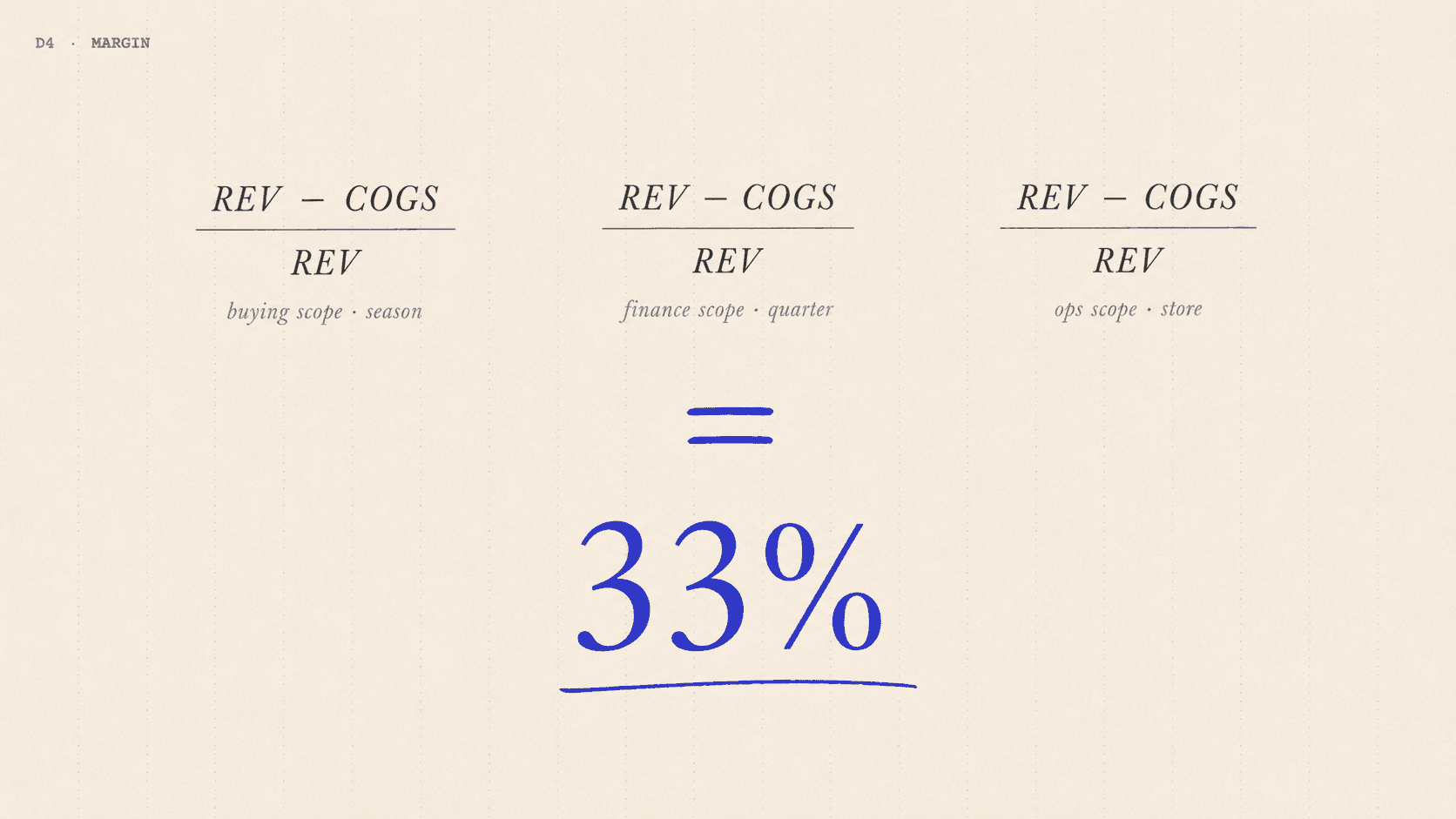
Buying counted at category level over the season. Finance counted at company level over the calendar quarter. Ops had a third version. Three numbers, three teams, one company. The CEO spent half her board meetings refereeing instead of deciding.
The numbers were correct. The conversation wasn't.
The Problematic
Each team had a legitimate margin. None of them matched.
Buying calculated gross margin per category over the full season. They included markdown impact and supplier rebates negotiated post-season. Finance calculated gross margin at company level over the calendar quarter. They excluded post-season rebates (not yet booked) and included transport costs (Buying didn't).
Ops calculated margin contribution per store, including operational costs. None of them was wrong. None of them matched. Every meeting started with 30 minutes of definition negotiation.
Three friction points:
Same KPI calculated three different ways across buying, finance, ops.
30 minutes per board meeting spent reconciling versions.
Strategic decisions delayed until everyone agreed on the baseline number.
The company didn't have one margin. It had three margins.
The Solution
One canonical margin definition, encoded in Solya.
The teams ran one workshop together. Each team explained their calculation, why it served their job, what they wouldn't compromise on. The conclusion: they didn't need one margin — they needed one canonical 'gross margin' that everyone agreed was the company-wide baseline, plus secondary versions for team-specific decisions.
The canonical definition was encoded in Solya's metrics layer. Every dashboard, every report, every board slide pulled from that single definition. The board meeting started with the same number on every slide. The company stopped negotiating definitions and started discussing actions.
One canonical "gross margin" as company baseline, governed by Solya.
Team-specific variations preserved as named secondary metrics.
Versioned governance — every change documented, searchable, auditable.
Definitions stopped being negotiated. They became governed.
How we did it
Inside the loop.
The unified definition ran on the Data Layer, with the metrics encoded once and propagated everywhere. Here's how the system works, end to end.
01 — Inventory each team's definition.
Buying, finance, and ops each documented how they calculated margin: scope, period, inclusions, exclusions. Differences became visible.
02 — Agree on a canonical version.
In one workshop, the teams aligned on a company-wide canonical 'gross margin' definition. Team-specific variations were preserved as named secondary metrics.
03 — Encode in the metrics layer.
The canonical definition and the secondary variations were encoded in Solya's metrics factory, with full transparency on the underlying logic.
04 — Connect every dashboard.
Every team's dashboards, reports, and board materials were rewired to read from the metrics layer. One source, multiple consumers.
05 — Govern over time.
When a definition needed adjustment, it went through a documented change process. Solya logged who, when, and why. The history was searchable.
Definitions stopped being negotiated. They became governed.
The Impacts
One number on every slide. Every meeting.
After the unified definition went live, the company stopped debating margin and started managing it.
1 definition — Of margin, used company-wide.
0 — Reconciliation time per board meeting.
3 → 1 — Versions of gross margin in production.
All teams — Aligned on the canonical number.
"The board meeting agenda finally started with a decision, not a debate."
— CFO
Explore more use cases
One platform. Every retail decision.
Inventory, allocation, pricing, planning, execution — connected in a single operational layer.