IT/Data
One feed for every alert that matters.

Aurélien

The retailer
An 11-store outdoor retailer, two buyers, five thousand SKUs.
Our retailer operates 11 stores across France in the outdoor and mountain technical segment. The team is small but sharp: a 2-person buying crew with deep category expertise, running roughly 5,000 SKUs in season.
The stack is mainstream for the sector — Ginkoia as core retail management, Shopify for e-commerce, and Excel as the connective tissue between everything else. It works. Until it doesn't.
"Every Monday started the same way: chasing alerts across email, Slack, and three different dashboards. By 10am I'd missed three."
— Operations Director
Context
Alerts everywhere, urgency nowhere.
2024. The outdoor retailer's operations director received alerts from five different sources every single day:
Email for supplier notifications. Slack for store managers. The buying tool for margin alerts. The warehouse system for stockouts. The e-com platform for out-of-stock SKUs.
No source was wrong. No source talked to the others.
Every Monday morning started the same way — twenty minutes of switching tabs to figure out what mattered. By 10am, the urgent stuff was usually missed in favor of the loud stuff.
The Problematic
Five alert sources, zero coordination.
Each system had legitimate alerting. The buying tool alerted on margin events. The warehouse system alerted on stock thresholds. Slack alerted on store conversations. Email captured supplier notifications. Each was useful in isolation. Together, they were noise.
The operations director ended up triaging alerts by which channel happened to ping most loudly. Quiet but critical alerts — a stockout forming on a hero SKU — lost to loud but minor ones — a supplier email about a meeting reschedule.
Three compounding problems emerged:
Five alert channels, none aware of the others.
Critical alerts lost in the volume of routine ones.
Triage by channel, not by impact.
The director didn't lack alerts. She lacked one place to read them.
The Solution
One feed, every alert, ranked by impact.
Solya pulled alerts from email, Slack, the buying tool, the warehouse system, and the e-com platform. Each alert was tagged with type, severity, and impact estimate.
The operations director's morning view became a single prioritized feed:
High-impact alerts at the top, with context and recommended actions.
Low-impact ones grouped or dismissed automatically.
Everything searchable, exportable, traceable.
Mondays started with a list of ten things to act on, ordered by impact. Not a chase across five tabs.
How we did it
Inside the loop.
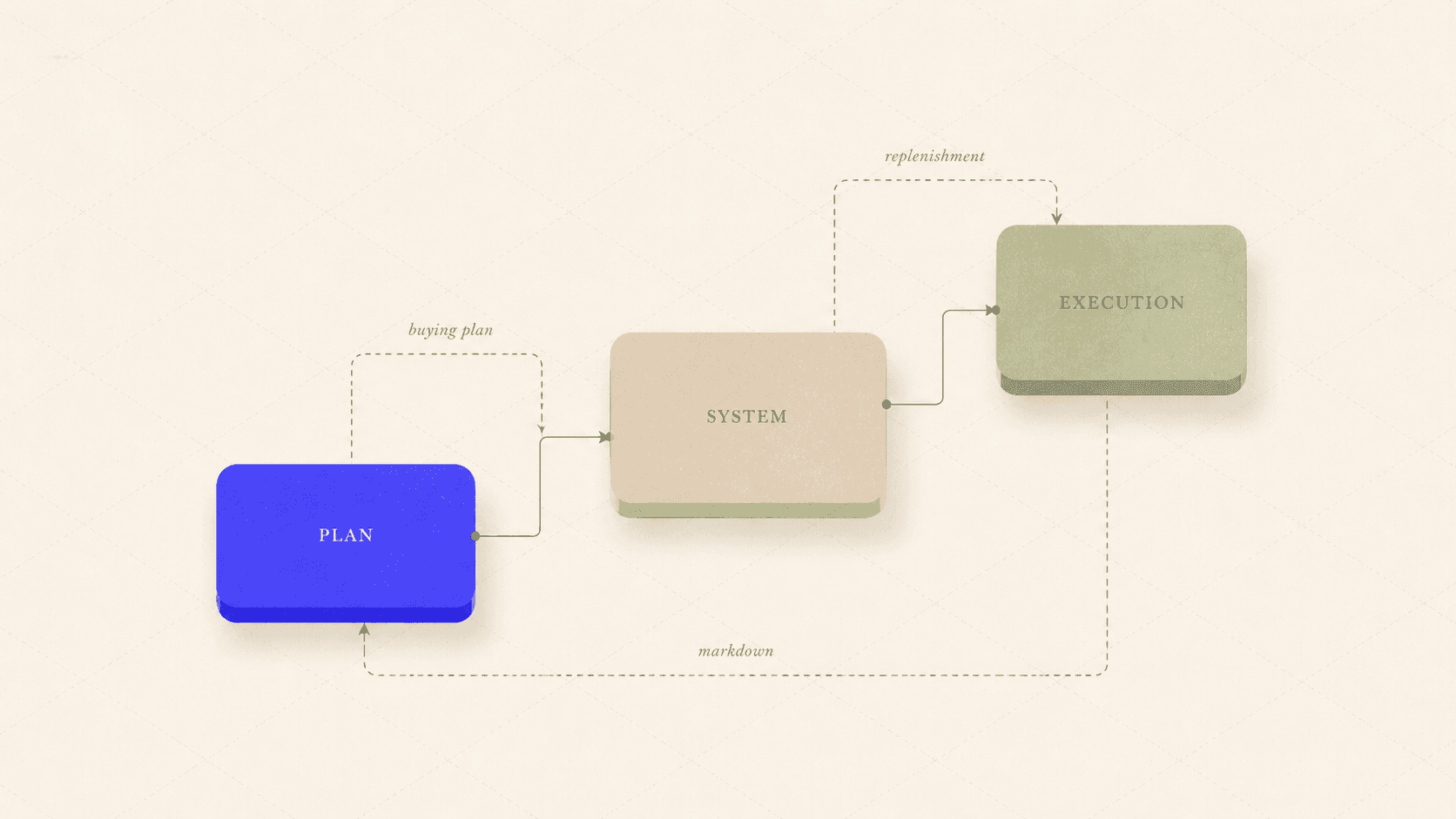
The unified alert feed runs on the Application Layer, drawing from every source and prioritizing automatically. Here's how the system works, end to end.
01 — Connect every alert source.
Solya plugged into email, Slack, the buying tool, the warehouse system, and the e-com platform. Every alert flowed into the central layer — no source left behind.
02 — Tag and classify.
Each alert was tagged with type, severity, source, and an impact estimate computed from historical patterns and business rules. The classification ran in real-time.
03 — Prioritize automatically.
Alerts were ranked by expected impact on revenue, margin, or stock cover. Top alerts surfaced with full context. Routine alerts grouped quietly in the background.
04 — Surface in one feed.
The operations director's Solya app showed the unified feed every morning. Each alert had a 'why this matters' note and a recommended action attached.
05 — Track and learn.
When alerts were acted on or dismissed, Solya logged the outcome. Prioritization improved over time as the system learned what truly mattered to this retailer.
Five sources kept producing alerts. The director just had one place to read them.
The Impacts
Mondays that start with action, not search.
After the unified feed went live, the operations director recovered her morning hours and stopped missing critical alerts in the noise.
1 feed — Replacing 5 alert sources
Prioritized — By impact and urgency
20 min — Reclaimed every Monday morning
+40% — High-impact alerts acted on within 24h
"I stopped chasing alerts. I started acting on them."
— Operations Director
Explore more use cases
One platform. Every retail decision.
Inventory, allocation, pricing, planning, execution — connected in a single operational layer.