Buying
Open-to-buy, managed live.

Aurélien

The retailer
A 16-store sport retailer, three buyers, seven thousand SKUs.
Our retailer operates 16 stores across France in the sport multi-brand specialty segment — running, fitness, technical apparel. The buying team is structured: a 3-person buying crew plus a dedicated allocator, running roughly 7,000 SKUs in season.
The stack is mainstream for the sector — Ginkoia as core retail management, Shopify for e-commerce, and Excel as the connective tissue between everything else. It works. Until it doesn't.
"We knew our budget. We just couldn't see it move."
— Head of Buying
Context
Three buyers, one budget, one Excel that nobody trusted.
FW 2024. The retailer was running on its biggest seasonal budget yet, with new supplier deals signed for running and fitness. The buying team had committed early on the high-volume categories, leaving room for late-season opportunistic buys.
But by mid-season, no one could tell where the open-to-buy actually stood. The shared Excel showed €280k of remaining budget; the supplier orders showed €340k already committed. Three meetings later, the team realized they'd already overshot — by 6 weeks.
The team had a budget. They just couldn't manage it as a team.
The Problematic
Open-to-buy lived in a spreadsheet that updated once a week.
Every Friday, the merchandising lead pulled invoices from Ginkoia, supplier confirmations from emails, and pending POs from a shared drive. She rebuilt the OTB tracker manually, line by line.
By Monday, the file was already stale. Three buyers committed to new suppliers in parallel without seeing each other's moves. The merchandising lead became the bottleneck — and the only person who knew the real number.
The symptoms were predictable:
OTB tracker rebuilt every week, never live, never trusted.
Three buyers committing in parallel without shared visibility.
Real budget overshot by 4 to 6 weeks before anyone noticed.
The team had a budget. They just couldn't manage it as a team.
The Solution
One live OTB, shared by every buyer in the team.
Solya plugged into Ginkoia, supplier feeds, and the team's PO system. Every committed amount, every confirmed delivery, every pending order surfaced live in one shared dashboard.
Buyers saw their available budget in real time, by category and by month. When one of them committed €40k on a running supplier, the others saw the OTB update before the next coffee. No more weekly rebuild, no more end-of-month surprises.
Live position computed every five minutes, across all spend sources.
Personal + team views — each buyer sees their slice and the bigger picture.
Budget alerts at 90% category capacity, before overshoot happens.
The merchandising lead stopped being the bottleneck. She became a strategist again.
How we did it
Inside the loop.
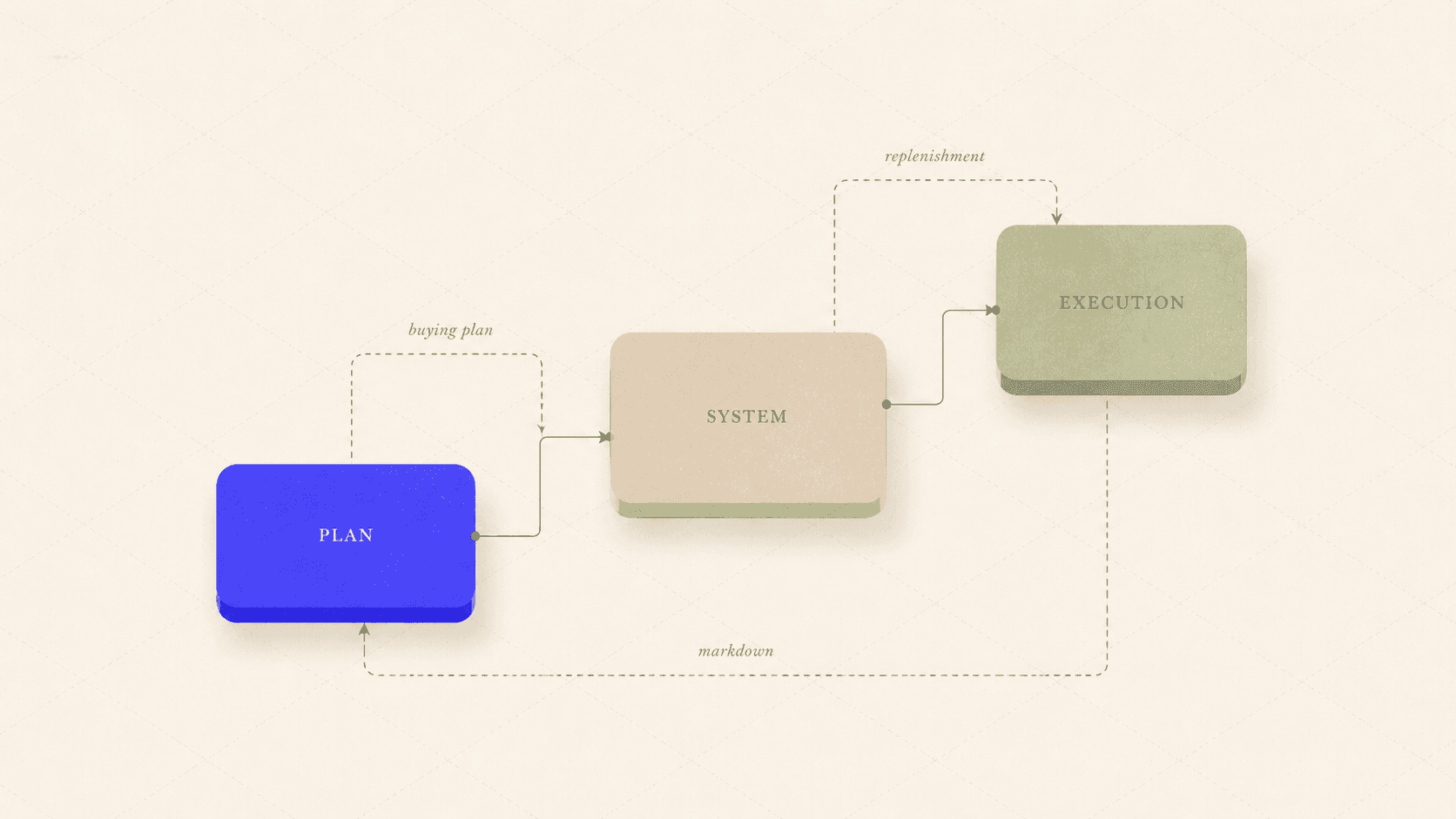
The live OTB runs on the Application Layer, in a continuous loop between the systems, the buyers, and the merchandising lead.
01 — Connect every spend source.
Solya ingested invoices from Ginkoia, confirmed POs from suppliers, and pending commitments from the team's shared drive. Five days from contract to live data.
02 — Structure by category and month.
Every spend was tagged by category, supplier, and target month. The OTB became queryable on any axis, instantly.
03 — Compute the live position.
Solya calculated the open budget per category and per month, every five minutes. The number was always up to date.
04 — Surface to every buyer.
Each buyer saw a personal view of their available budget, plus the team-wide picture. New commitments were visible to everyone, the moment they were made.
05 — Alert before it overflows.
When a category hit 90% of its allocated budget, Solya flagged it to the buyer and the merchandising lead. No more surprises at month-end.
The OTB stopped being a weekly battle. It became a live conversation.
The Impacts
A budget the team manages together, in real time.
After two seasons running on the Solya OTB loop, the buying team operated on shared truth — and the merchandising lead got her strategic role back.
Real-time — OTB visibility across the buying team.
0 — Weekly reconciliation meetings.
+8% — Budget efficiency on opportunistic late-season buys.
1 source — Of truth shared by 3 buyers and 1 merchandising lead.
"I stopped being the person who held the spreadsheet. I went back to being a buyer."
— Merchandising Lead
Explore more use cases
One platform. Every retail decision.
Inventory, allocation, pricing, planning, execution — connected in a single operational layer.