Operations
Real-time signals on real data.

Aurélien

The retailer
An 11-store outdoor retailer, two buyers, five thousand SKUs.
Our retailer operates 11 stores across France in the outdoor and mountain technical segment. The team is small but sharp: a 2-person buying team with deep category expertise, running roughly 5,000 SKUs in season.
The stack is mainstream for the sector — Ginkoia as core retail management, Shopify for e-commerce, and Excel as the connective tissue between everything else. It works. Until it doesn't.
"We had alerts in our heads, not in our systems. By the time someone said it out loud, the moment had passed."
— Operations Lead
Context
An outdoor retailer running a high-velocity catalog with no live signals.
FW 2024. The outdoor retailer carried 5,000 SKUs in season, with strong weather sensitivity and heavy weekend volumes. Stockouts mattered: a missed sale on a technical jacket during a cold snap was a missed sale that wouldn't come back.
But the team had no automated signal system. Anomalies — stockouts forming, margin drops, slow movers — were noticed when someone happened to look at a specific report. Most of the time, that happened too late.
The data was alive. The response wasn't.
The Problematic
The data showed everything. The team saw nothing in time.
All the right data existed in Ginkoia and the e-com platform. But surfacing it required someone to actively pull a report and read it. The team had three people, dozens of categories, and no signal automation.
Stockout windows were caught by chance. Margin drops on specific SKUs were noticed in the next monthly review. Slow movers were spotted six weeks too late. The data was alive — the response was not.
Three gaps compounded:
No automated detection of stockouts forming, only reactive observation.
Margin and demand drift discovered in monthly reviews, never live.
Critical alerts traveled by Slack, email, or word-of-mouth, often missed.
The team didn't lack data. They lacked a way for the data to reach them in time.
The Solution
Five signal types, live, routed automatically.
Solya watches the retailer's data in real time and fires signals when conditions are met: stockout windows opening on bestsellers, margin drops on specific SKUs, slow movers forming, demand spikes on weather-sensitive products, anomalies in conversion. Each signal is routed to the right team — buying, ops, store, marketing — through the right channel.
The team stopped relying on Monday reviews. They started managing their week from the signals that arrived live, with context, with confidence levels, and with a recommended action.
5 signal types monitored continuously across the network.
Threshold-based detection, tuned with the team over weeks.
Routed by team — buying, ops, stores, marketing — to the right channel.
The team stopped looking for signals. The signals came to them.
How we did it
Inside the loop.
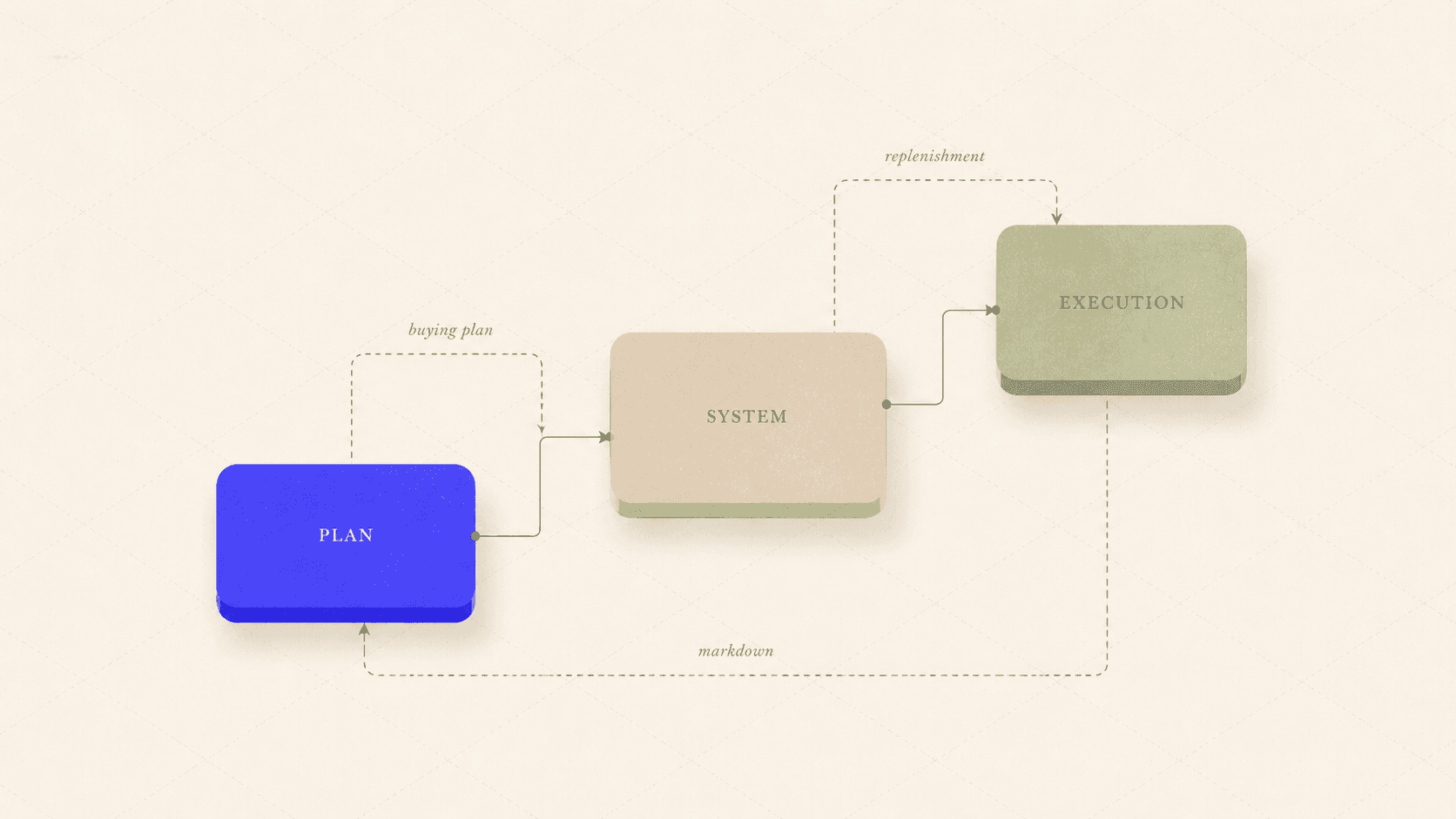
The signal layer ran on the Intelligence Layer, with the team defining the rules and the AI watching continuously. Here's how the system works, end to end.
01 — Define signal types.
The team picked five signal types worth automating: stockouts forming, margin drops, slow movers, demand spikes, conversion anomalies. Each came with a clear definition.
02 — Set thresholds with the team.
For each signal, the team set thresholds with Solya: when does a stockout 'count'? what margin drop matters? what defines a slow mover? Thresholds were tuned over weeks.
03 — Connect to live data.
Solya monitored Ginkoia, the e-com platform, and POS in real time. Every transaction, every stock movement, every margin event was evaluated against the signal rules.
04 — Route to the right team.
Each signal had a target: buying for slow movers, ops for stockouts, store managers for conversion anomalies, marketing for demand spikes. Signals arrived in Slack, in-app, or by email.
05 — Track signal-to-action.
Every signal logged its outcome: was it acted on? in how long? with what result? Solya learned which signals mattered, which were noise, and refined the thresholds over time.
The team stopped looking for signals. The signals came to them.
The Impacts
Operations that runs on signals, not on reports.
After six months running with the signal layer live, the team operated on a continuous flow of relevant alerts — and Monday reviews became strategic, not diagnostic.
Minutes — From event to alert.
5 signal types — Live across the network.
Right team — Right alert, every time.
70% — Of alerts acted on within 24 hours.
"We stopped pulling reports. The signals just arrive."
— Operations Lead
Explore more use cases
One platform. Every retail decision.
Inventory, allocation, pricing, planning, execution — connected in a single operational layer.